Pearson+ LogoPearson+ Logo
Ch. 5 The Working Cell
Taylor - Campbell Biology: Concepts & Connections 10th Edition
Taylor, Simon, Dickey, Hogan10th EditionCampbell Biology: Concepts & ConnectionsISBN: 9780136538783Not the one you use?Change textbook
Chapter 5, Problem 9

Why is the barrier of the activation energy beneficial for cells? Explain how enzymes lower activation energy.

Verified step by step guidance
1
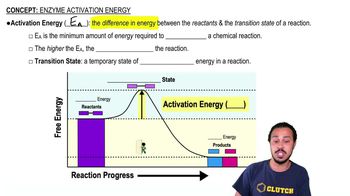
Understand the concept of activation energy: Activation energy is the minimum amount of energy required to start a chemical reaction. In biological systems, this energy barrier prevents molecules from undergoing spontaneous reactions, which could be harmful or wasteful for the cell.
Recognize the role of activation energy in cellular regulation: By having an energy barrier, cells can control when and where reactions occur. This regulation ensures that metabolic processes happen in an orderly and efficient manner, contributing to the overall homeostasis and health of the organism.
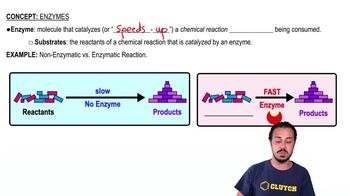
Learn about enzymes: Enzymes are biological catalysts that speed up chemical reactions in cells without being consumed in the process. They are crucial for facilitating nearly all biochemical reactions necessary for life.
Explore how enzymes lower activation energy: Enzymes lower the activation energy by stabilizing the transition state of the reaction. They provide an alternative reaction pathway with a lower energy hill to climb compared to the reaction without the enzyme. This makes it easier for reactants to reach the transition state and convert into products.
Understand the benefits of enzymes in biological systems: By lowering activation energy, enzymes allow reactions to occur rapidly and at lower temperatures than would otherwise be necessary. This efficiency is vital for maintaining life processes within the narrow temperature ranges suitable for living organisms.

Verified video answer for a similar problem:

This video solution was recommended by our tutors as helpful for the problem above.
Video duration:
1m
Was this helpful?

Key Concepts

Here are the essential concepts you must grasp in order to answer the question correctly.

Activation Energy

Activation energy is the minimum energy required for a chemical reaction to occur. It acts as a barrier that prevents reactions from happening spontaneously at room temperature, ensuring that cellular processes occur in a controlled manner. This regulation is crucial for maintaining homeostasis and allowing cells to respond to environmental changes.
Recommended video:
Guided course
04:18
Enzyme Activation Energy

Enzymes

Enzymes are biological catalysts that speed up chemical reactions by lowering the activation energy required. They achieve this by providing an alternative reaction pathway, stabilizing the transition state, and facilitating the formation of products. This efficiency allows cells to carry out essential metabolic processes at much lower temperatures than would otherwise be necessary.
Recommended video:

Catalysis

Catalysis is the process by which a substance (catalyst) increases the rate of a chemical reaction without being consumed in the process. In biological systems, enzymes serve as catalysts, enabling reactions to occur more rapidly and efficiently. By lowering activation energy, enzymes ensure that metabolic reactions can proceed quickly enough to sustain life.
Recommended video: