Ch. 3 - Derivatives
Briggs - Calculus: Early Transcendentals 3rd Edition
Briggs3rd EditionCalculus: Early TranscendentalsISBN: 9780136847243Not the one you use?Change textbook
Chapter 3, Problem 77c

For x > 0, what is f′(x)?

Verified step by step guidance
1
Step 1: Identify the function f(x) that you need to differentiate. Without the specific function, we cannot proceed with finding f'(x).
Step 2: Once you have the function f(x), determine the type of function it is (e.g., polynomial, exponential, trigonometric, etc.) to decide the appropriate differentiation rules to apply.
Step 3: Apply the differentiation rules. For example, if f(x) is a polynomial, use the power rule: if f(x) = x^n, then f'(x) = n*x^(n-1).
Step 4: If the function is a combination of different types (e.g., a product or quotient of functions), use the product rule or quotient rule as necessary. The product rule is: (uv)' = u'v + uv'. The quotient rule is: (u/v)' = (u'v - uv')/v^2.
Step 5: Simplify the derivative expression, if possible, to obtain the most concise form of f'(x).

Verified video answer for a similar problem:

This video solution was recommended by our tutors as helpful for the problem above.
Video duration:
4m
Was this helpful?

Key Concepts

Here are the essential concepts you must grasp in order to answer the question correctly.

Derivative

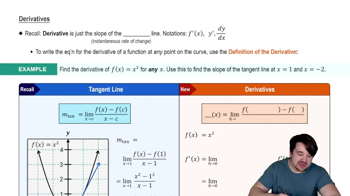
The derivative of a function measures how the function's output value changes as its input value changes. It is defined as the limit of the average rate of change of the function over an interval as the interval approaches zero. In notation, if f(x) is a function, its derivative f'(x) represents the slope of the tangent line to the curve at any point x.
Recommended video:
05:44
Derivatives

Function Notation

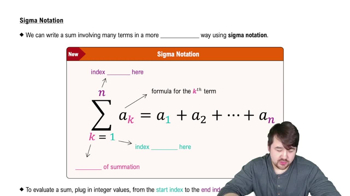
Function notation is a way to denote a function and its outputs. For example, f(x) indicates a function named 'f' evaluated at the input 'x'. Understanding this notation is crucial for interpreting questions about derivatives, as it allows us to identify the specific function we are differentiating and the variable with respect to which we are differentiating.
Recommended video:
04:22
Sigma Notation

Limits

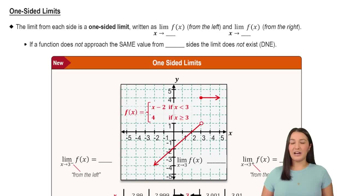
Limits are fundamental in calculus, particularly in defining derivatives. A limit describes the behavior of a function as its input approaches a certain value. In the context of derivatives, the limit is used to find the instantaneous rate of change of a function at a specific point, which is essential for calculating f'(x) accurately.
Recommended video:
05:50
One-Sided Limits