Angle to a particle (part 2) The figure in Exercise 81 shows the particle traveling away from the sensor, which may have influenced your solution (we expect you used the inverse sine function). Suppose instead that the particle approaches the sensor (see figure). How would this change the solution? Explain the differences in the two answers. <IMAGE>
Ch. 3 - Derivatives
Briggs3rd EditionCalculus: Early TranscendentalsISBN: 9780136847243Not the one you use?Change textbook
Chapter 3, Problem 3.10.17
Evaluate the derivative of the following functions.
f(x) = sin-1 (e-2x)
Verified step by step guidance1
Step 1: Recognize that the function f(x) = \(\sin\)^{-1}(e^{-2x}) is an inverse trigonometric function composed with an exponential function. To find the derivative, we will use the chain rule.
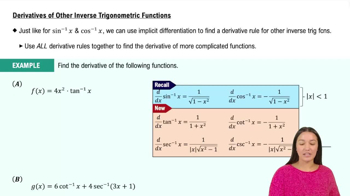
Step 2: Recall the derivative of the inverse sine function: \( \frac{d}{dx} [\sin^{-1}(u)] = \frac{1}{\sqrt{1-u^2}} \cdot \frac{du}{dx} \). Here, u = e^{-2x}.
Step 3: Differentiate the inner function u = e^{-2x} with respect to x. The derivative of e^{-2x} is \( \frac{d}{dx}[e^{-2x}] = -2e^{-2x} \).
Step 4: Substitute the derivative of the inner function and the expression for u into the derivative formula for the inverse sine function: \( \frac{d}{dx} [\sin^{-1}(e^{-2x})] = \frac{1}{\sqrt{1-(e^{-2x})^2}} \cdot (-2e^{-2x}) \).
Step 5: Simplify the expression: The derivative is \( \frac{-2e^{-2x}}{\sqrt{1-e^{-4x}}} \).

Verified video answer for a similar problem:
This video solution was recommended by our tutors as helpful for the problem above.
Video duration:
3mWas this helpful?
Key Concepts
Here are the essential concepts you must grasp in order to answer the question correctly.
Derivative
The derivative of a function measures how the function's output value changes as its input changes. It is defined as the limit of the average rate of change of the function over an interval as the interval approaches zero. In calculus, the derivative is often denoted as f'(x) or df/dx, and it provides critical information about the function's behavior, such as its slope and points of tangency.
Recommended video:
Derivatives
Inverse Trigonometric Functions
Inverse trigonometric functions, such as sin<sup>-1</sup>(x), are the functions that reverse the action of the standard trigonometric functions. For example, sin<sup>-1</sup>(x) gives the angle whose sine is x. These functions have specific domains and ranges, and their derivatives can be derived using implicit differentiation or known derivative formulas, which are essential for evaluating derivatives involving these functions.
Recommended video:
Derivatives of Other Inverse Trigonometric Functions
Chain Rule
The chain rule is a fundamental technique in calculus used to differentiate composite functions. It states that if a function y = f(g(x)) is composed of two functions, the derivative can be found by multiplying the derivative of the outer function f with the derivative of the inner function g. This rule is particularly useful when dealing with functions like f(x) = sin<sup>-1</sup>(e<sup>-2x</sup>), where the inner function e<sup>-2x</sup> must be differentiated alongside the outer inverse sine function.
Recommended video:
Intro to the Chain Rule
Related Practice
Textbook Question
133
views
Textbook Question
49–55. Derivatives of tower functions (or g^h) Find the derivative of each function and evaluate the derivative at the given value of a.
h (x) = x^√x; a = 4
157
views
Textbook Question
Find y'' for the following functions.
y = cos θ sin θ
298
views
Textbook Question
Find the derivative of the following functions.
y = In √x⁴+x²
237
views
Textbook Question
15–48. Derivatives Find the derivative of the following functions.
y = 10^In 2x
362
views
Textbook Question
A 12-ft ladder is leaning against a vertical wall when Jack begins pulling the foot of the ladder away from the wall at a rate of 0.2 ft/s. What is the configuration of the ladder at the instant when the vertical speed of the top of the ladder equals the horizontal speed of the foot of the ladder?
260
views