Ch. 10 - Sequences and Infinite Series
Briggs - Calculus: Early Transcendentals 3rd Edition
Briggs3rd EditionCalculus: Early TranscendentalsISBN: 9780136847243Not the one you use?Change textbook
Chapter 10, Problem 10.3.41

21–42. Geometric series Evaluate each geometric series or state that it diverges.  


41.∑ (k = 1 to ∞) 4 / 12ᵏ

Verified step by step guidance
1
Identify the first term \( a \) and the common ratio \( r \) of the geometric series. Here, the series is \( \sum_{k=1}^{\infty} \frac{4}{12^k} \), so the first term is \( a = \frac{4}{12^1} = \frac{4}{12} \).
Express the series in the standard geometric series form \( \sum_{k=0}^{\infty} ar^k \) by adjusting the index if necessary. Since the sum starts at \( k=1 \), rewrite it as \( \sum_{k=0}^{\infty} ar^k \) with \( a = \frac{4}{12} \) and \( r = \frac{1}{12} \).
Check the convergence of the series by evaluating the absolute value of the common ratio \( |r| \). If \( |r| < 1 \), the series converges; otherwise, it diverges.
If the series converges, use the formula for the sum of an infinite geometric series starting at \( k=0 \): \(\n\[\n\)\$\$ S = \(\frac{a}{1 - r}\) \$\$\(\n\]\nwhere\) \( a \) is the first term and \( r \) is the common ratio.
Calculate the sum using the values of \( a \) and \( r \) identified, keeping the expression symbolic without simplifying to a final decimal value.

Verified video answer for a similar problem:

This video solution was recommended by our tutors as helpful for the problem above.
Video duration:
2m
Was this helpful?

Key Concepts

Here are the essential concepts you must grasp in order to answer the question correctly.

Geometric Series

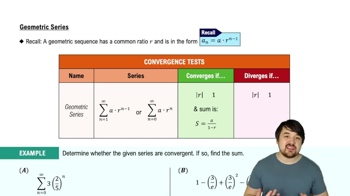
A geometric series is a sum of terms where each term is found by multiplying the previous term by a constant ratio. It has the form ∑ ar^(k), where a is the first term and r is the common ratio. Understanding this structure is essential to evaluate or determine the convergence of the series.
Recommended video:
06:00
Geometric Series

Convergence Criteria for Geometric Series

A geometric series converges if and only if the absolute value of the common ratio |r| is less than 1. If |r| ≥ 1, the series diverges. This criterion helps decide whether the infinite sum has a finite value or not.
Recommended video:
06:00
Geometric Series

Sum Formula for Convergent Geometric Series

When a geometric series converges, its sum can be calculated using the formula S = a / (1 - r), where a is the first term and r is the common ratio. This formula provides a quick way to find the total sum of infinitely many terms.
Recommended video:
06:00
Geometric Series