Ch. 3 - Derivatives
Briggs - Calculus: Early Transcendentals 3rd Edition
Briggs3rd EditionCalculus: Early TranscendentalsISBN: 9780136847243Not the one you use?Change textbook
Chapter 3, Problem 3.11.42

A 12-ft ladder is leaning against a vertical wall when Jack begins pulling the foot of the ladder away from the wall at a rate of 0.2 ft/s. What is the configuration of the ladder at the instant when the vertical speed of the top of the ladder equals the horizontal speed of the foot of the ladder?

Verified step by step guidance
1
Start by setting up a coordinate system where the wall is the y-axis and the ground is the x-axis. Let x be the distance from the wall to the foot of the ladder, and y be the height of the ladder on the wall. The ladder forms a right triangle with the wall and the ground.
Use the Pythagorean theorem to relate x and y: x^2 + y^2 = 12^2. This equation represents the constant length of the ladder.
Differentiate both sides of the equation with respect to time t to find the relationship between the rates of change of x and y. This gives: 2x(dx/dt) + 2y(dy/dt) = 0.
Substitute the given rate dx/dt = 0.2 ft/s into the differentiated equation. This will allow you to solve for dy/dt, the rate at which the top of the ladder is moving down the wall.
Set dy/dt equal to dx/dt to find the configuration where the vertical speed of the top of the ladder equals the horizontal speed of the foot of the ladder. Solve the resulting equation for x and y to find the specific configuration of the ladder.

Verified video answer for a similar problem:

This video solution was recommended by our tutors as helpful for the problem above.
Video duration:
5m
Was this helpful?

Key Concepts

Here are the essential concepts you must grasp in order to answer the question correctly.

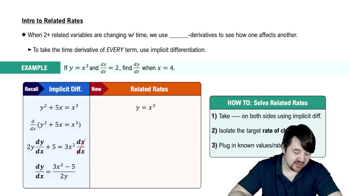
Related Rates

Related rates involve finding the rate at which one quantity changes in relation to another. In this problem, the rates of change of the horizontal distance of the ladder's foot from the wall and the vertical height of the ladder's top are interconnected. By applying the chain rule, we can relate these rates to the geometry of the situation.
Recommended video:
04:16
Intro To Related Rates

Pythagorean Theorem

The Pythagorean theorem states that in a right triangle, the square of the length of the hypotenuse is equal to the sum of the squares of the lengths of the other two sides. In this scenario, the ladder, the wall, and the ground form a right triangle, where the ladder is the hypotenuse. This relationship is crucial for establishing the relationship between the vertical and horizontal distances.
Recommended video:
06:11
Fundamental Theorem of Calculus Part 1

Instantaneous Rate of Change

The instantaneous rate of change refers to how a quantity changes at a specific moment in time. In this context, we are interested in the moment when the vertical speed of the ladder's top equals the horizontal speed of the foot. Understanding this concept allows us to set up equations that can be solved to find the configuration of the ladder at that instant.
Recommended video:
04:16
Intro To Related Rates