

Ch. 2 - Limits and Continuity
Hass - Thomas' Calculus 15th Edition
Hass15th EditionThomas' CalculusISBN: 9780137616077Not the one you use?Change textbook
Chapter 2, Problem 22

Finding Limits
In Exercises 9–24, find the limit or explain why it does not exist.


lim x →π cos² (x― tan x)

Verified step by step guidance
1
First, understand the expression for which you need to find the limit: \( \lim_{x \to \pi} \cos^2(x - \tan x) \). This involves the cosine function squared, evaluated at \( x - \tan x \).
Next, evaluate the behavior of \( x - \tan x \) as \( x \) approaches \( \pi \). Since \( \tan x \) is undefined at \( x = \pi \), consider the behavior of \( \tan x \) near \( \pi \).
Recognize that \( \tan x \) approaches 0 as \( x \) approaches \( \pi \) from either side, because \( \tan(\pi) = 0 \). Therefore, \( x - \tan x \) approaches \( \pi \) as \( x \to \pi \).
Substitute the limit of \( x - \tan x \) into the cosine function: \( \cos^2(x - \tan x) \to \cos^2(\pi) \). Recall that \( \cos(\pi) = -1 \), so \( \cos^2(\pi) = (-1)^2 = 1 \).
Conclude that the limit of the original expression is \( 1 \), as the squared cosine of \( \pi \) is \( 1 \). Thus, \( \lim_{x \to \pi} \cos^2(x - \tan x) = 1 \).

Verified video answer for a similar problem:

This video solution was recommended by our tutors as helpful for the problem above.
Video duration:
1m
Was this helpful?

Key Concepts

Here are the essential concepts you must grasp in order to answer the question correctly.

Limits

A limit is a fundamental concept in calculus that describes the behavior of a function as its input approaches a certain value. It helps in understanding the function's value at points where it may not be explicitly defined. For example, limits are essential for evaluating functions at points of discontinuity or for determining the behavior of functions at infinity.
Recommended video:
05:50
One-Sided Limits

Trigonometric Functions

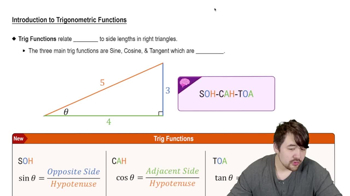
Trigonometric functions, such as cosine and tangent, are periodic functions that relate angles to ratios of sides in right triangles. Understanding these functions is crucial for evaluating limits involving angles, especially when they approach specific values like π. The behavior of these functions near their critical points can significantly affect the limit's outcome.
Recommended video:
6:04
Introduction to Trigonometric Functions

Continuity

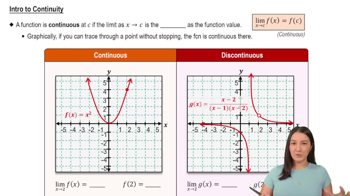
Continuity refers to a property of functions where small changes in the input result in small changes in the output. A function is continuous at a point if the limit as the input approaches that point equals the function's value at that point. This concept is vital when finding limits, as it helps determine whether a limit exists and if it can be evaluated directly.
Recommended video:
05:34
Intro to Continuity
Related Practice
Textbook Question

[Technology Exercise] Let f(t) = 1/t for t≠0.


a. Find the average rate of change of f with respect to t over the intervals (i) from t=2 to t=3, and (ii) from t=2 to t=T.


b. Make a table of values of the average rate of change of f with respect to t over the interval [2,T], for some values of T approaching 2, say T = 2.1, 2.01, 2.001, 2.0001, 2.00001, and 2.000001.


c. What does your table indicate is the rate of change of f with respect to t at t=2?

298
views
Textbook Question

The accompanying graph shows the total distance s traveled by a bicyclist after t hours.

b. Estimate the bicyclist’s instantaneous speed at the times t=1/2, t=2, and t=3.

400
views
Textbook Question

The accompanying graph shows the total amount of gasoline A in the gas tank of an automobile after it has been driven for t days.

c. Estimate the maximum rate of gasoline consumption and the specific time at which it occurs.

315
views
Textbook Question

The accompanying figure shows the plot of distance fallen versus time for an object that fell from the lunar landing module a distance 80 m to the surface of the moon.


a. Estimate the slopes of the secant lines PQ₁, PQ₂, PQ₃, and PQ₄, arranging them in a table like the one in Figure 2.6.


b. About how fast was the object going when it hit the surface?


290
views
Textbook Question

Finding Limits

In Exercises 9–24, find the limit or explain why it does not exist.


lim h →0 ((x + h)² ― x²)/h

303
views
Textbook Question

Finding Limits


In Exercises 9–24, find the limit or explain why it does not exist.


lim x →π sin (x/2 + sin x)

285
views