
Ch. 10 - Sequences and Infinite Series
Briggs - Calculus: Early Transcendentals 3rd Edition
Briggs3rd EditionCalculus: Early TranscendentalsISBN: 9780136847243Not the one you use?Change textbook
Chapter 10, Problem 10.3.71a

71. Evaluating an infinite series two ways
Evaluate the series
∑ (k = 1 to ∞) (4 / 3ᵏ – 4 / 3ᵏ⁺¹) two ways.
a. Use a telescoping series argument.

Verified step by step guidance
1
Write out the general term of the series explicitly: \(a_k = \frac{4}{3^k} - \frac{4}{3^{k+1}}\).
Recognize that this is a telescoping series because each term can be rewritten to show cancellation between consecutive terms when summed.
Express the partial sum \(S_n = \sum_{k=1}^n \left( \frac{4}{3^k} - \frac{4}{3^{k+1}} \right)\) and write out the first few terms to observe the telescoping pattern.
Notice that most terms cancel out, leaving only the first term of the first fraction and the last term of the second fraction in the partial sum.
Write the simplified form of \(S_n\) after cancellation and then take the limit as \(n \to \infty\) to find the sum of the infinite series.

Verified video answer for a similar problem:

This video solution was recommended by our tutors as helpful for the problem above.
Video duration:
3m
Was this helpful?

Key Concepts

Here are the essential concepts you must grasp in order to answer the question correctly.

Telescoping Series

A telescoping series is a series where many terms cancel out when the partial sums are expanded, leaving only a few terms to evaluate. This simplification makes it easier to find the sum of the infinite series by focusing on the first and last terms of the partial sums.
Recommended video:
06:00
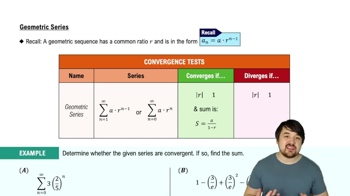
Geometric Series

Infinite Geometric Series

An infinite geometric series has terms that multiply by a constant ratio each time. If the absolute value of the ratio is less than one, the series converges, and its sum can be found using the formula S = a / (1 - r), where a is the first term and r is the common ratio.
Recommended video:
06:00
Geometric Series

Partial Sums and Convergence

Partial sums are the sums of the first n terms of a series. Understanding how these sums behave as n approaches infinity helps determine if the series converges and what its sum is. For telescoping and geometric series, analyzing partial sums is key to evaluating the infinite sum.
Recommended video:
08:01
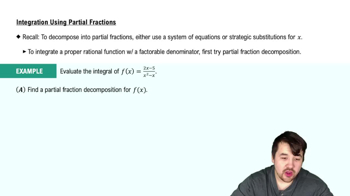
Integration Using Partial Fractions
Related Practice
Textbook Question

Explain why or why not

Determine whether the following statements are true and give an explanation or counterexample.

a. If the Limit Comparison Test can be applied successfully to a given series with a certain comparison series, the Comparison Test also works with the same comparison series.

46
views
Textbook Question

Explain why or why not Determine whether the following statements are true and give an explanation or counterexample.

a. Suppose 0 < aₖ < bₖ. If ∑ (k = 1 to ∞) aₖ converges, then ∑ (k = 1 to ∞) bₖ converges.

36
views
Textbook Question

57–60. Heights of bouncing balls A ball is thrown upward to a height of hₒ meters. After each bounce, the ball rebounds to a fraction r of its previous height. Let hₙ be the height after the nth bounce. Consider the following values of hₒ and r.


a. Find the first four terms of the sequence of heights {hₙ}.


h₀ = 20,r = 0.5

52
views
Textbook Question

Explain why or why not

Determine whether the following statements are true and give an explanation or counterexample.


a.The sequence of partial sums for the series1 + 2 + 3 + ⋯ is {1, 3, 6, 10, …}.

68
views
Textbook Question

Explain why or why not Determine whether the following statements are true and give an explanation or counterexample.


a. A series that converges must converge absolutely.

48
views
Textbook Question

72–75. {Use of Tech} Practical sequences

Consider the following situations that generate a sequence


a.Write out the first five terms of the sequence.


Radioactive decay

A material transmutes 50% of its mass to another element every 10 years due to radioactive decay. Let Mₙ be the mass of the radioactive material at the end of the nᵗʰ decade, where the initial mass of the material is M₀ = 20g.

50
views