

Ch. 4 - Applications of the Derivative
Briggs - Calculus: Early Transcendentals 3rd Edition
Briggs3rd EditionCalculus: Early TranscendentalsISBN: 9780136847243Not the one you use?Change textbook
Chapter 4, Problem 4.1.77a

Explain why or why not Determine whether the following statements are true and give an explanation or counterexample.


a. The function f(x) = √x has a local maximum on the interval [0,∞).

Verified step by step guidance
1
To determine if the function f(x) = √x has a local maximum on the interval [0, ∞), we first need to understand what a local maximum is. A function f(x) has a local maximum at a point x = c if there exists an interval (a, b) containing c such that f(c) ≥ f(x) for all x in (a, b).
Next, consider the behavior of the function f(x) = √x. As x increases from 0 to ∞, the value of √x also increases. This suggests that the function is monotonically increasing on the interval [0, ∞).
To further analyze, we can take the derivative of f(x) to examine its critical points. The derivative f'(x) = (1/2)x^(-1/2) is positive for all x > 0, indicating that the function is increasing on its entire domain.
Since the function is increasing and has no points where the derivative is zero or undefined (other than at x = 0, where the derivative is undefined but the function is still increasing), there are no local maxima on the interval [0, ∞).
Therefore, the statement that the function f(x) = √x has a local maximum on the interval [0, ∞) is false. The function does not have a local maximum because it continuously increases without reaching a peak.

Verified video answer for a similar problem:

This video solution was recommended by our tutors as helpful for the problem above.
Video duration:
2m
Was this helpful?

Key Concepts

Here are the essential concepts you must grasp in order to answer the question correctly.

Local Maximum

A local maximum of a function occurs at a point where the function's value is greater than the values of the function at nearby points. To determine if a function has a local maximum, one typically examines the first derivative to find critical points and the second derivative to assess concavity. In the context of the given function, understanding local maxima is essential to evaluate its behavior over the specified interval.
Recommended video:
06:02
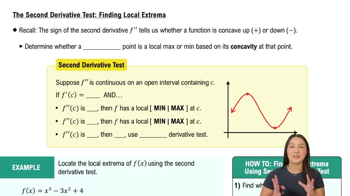
The Second Derivative Test: Finding Local Extrema

Derivative and Critical Points

The derivative of a function provides information about its rate of change and is used to find critical points, where the derivative is zero or undefined. These points are potential candidates for local maxima or minima. For the function f(x) = √x, calculating the derivative helps identify whether there are any points in the interval [0, ∞) where the function reaches a local maximum.
Recommended video:
04:50
Critical Points

Behavior of the Function on the Interval

Analyzing the behavior of the function on the specified interval is crucial for determining the presence of local maxima. For f(x) = √x, one must consider how the function behaves as x approaches 0 and as x increases towards infinity. Understanding the overall trend of the function helps in concluding whether it can attain a local maximum within the given interval.
Recommended video:
5:46
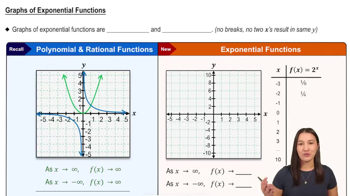
Graphs of Exponential Functions
Related Practice
Textbook Question

Folded boxes


a. Squares with sides of length x are cut out of each corner of a rectangular piece of cardboard measuring 5 ft by 8 ft. The resulting piece of cardboard is then folded into a box without a lid. Find the volume of the largest box that can be formed in this way.

319
views
Textbook Question

Maximizing profit Suppose a tour guide has a bus that holds a maximum of 100 people. Assume his profit (in dollars) for taking people on a city tour is P(n) = n(50 - 0.5n) - 100. (Although P is defined only for positive integers, treat it as a continuous function.)


a. How many people should the guide take on a tour to maximize the profit?

342
views
Textbook Question

Values of related functions Suppose f is differentiable on (-∞,∞) and assume it has a local extreme value at the point x = 2, where f(2) = 0. Let g(x) = xf(x) + 1 and let h(x) = xf(x) + x +1, for all values of x.


a. Evaluate g(2), h(2), g'(2), and h'(2).

240
views
Textbook Question

Sketch a graph of a function f with the following properties.


f' < 0 and f" < 0, for x < 3

347
views
Textbook Question

Suppose the objective function P= xy is subject to the constraint 10x + y = 100, where x and y are real numbers.


a. Eliminate the variable y from the objective function so that P is expressed as a function of one variable x.

276
views
Textbook Question

{Use of Tech} Fixed points of quadratics and quartics Let f(x) = ax(1 -x), where a is a real number and 0 ≤ a ≤ 1. Recall that the fixed point of a function is a value of x such that f(x) = x (Exercises 48–51). 


a. Without using a calculator, find the values of a, with 0 ≤ a ≤ 4, such that f  has a fixed point. Give the fixed point in terms of a. 

247
views