Ch. 1 - Functions
Briggs - Calculus: Early Transcendentals 3rd Edition
Briggs3rd EditionCalculus: Early TranscendentalsISBN: 9780136847243Not the one you use?Change textbook
Chapter 1, Problem 1.42

Solve each equation.
48=6e4k48=6e^{4k}

Verified step by step guidance
1
Start by isolating the exponential term. Divide both sides of the equation by 6 to get: \( e^{4k} = \frac{48}{6} \).
Simplify the right side of the equation: \( e^{4k} = 8 \).
To solve for \( k \), take the natural logarithm of both sides: \( \ln(e^{4k}) = \ln(8) \).
Use the property of logarithms that \( \ln(e^x) = x \) to simplify the left side: \( 4k = \ln(8) \).
Finally, solve for \( k \) by dividing both sides by 4: \( k = \frac{\ln(8)}{4} \).

Verified video answer for a similar problem:

This video solution was recommended by our tutors as helpful for the problem above.
Video duration:
2m
Was this helpful?

Key Concepts

Here are the essential concepts you must grasp in order to answer the question correctly.

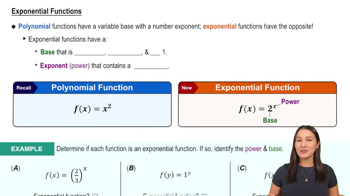
Exponential Functions

Exponential functions are mathematical expressions in the form of f(x) = a * e^(bx), where 'e' is the base of natural logarithms, approximately equal to 2.71828. These functions model growth or decay processes and are characterized by their rapid increase or decrease. Understanding how to manipulate and solve equations involving exponential functions is crucial for solving problems like the one presented.
Recommended video:
6:13
Exponential Functions

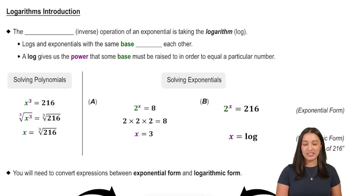
Logarithms

Logarithms are the inverse operations of exponentiation, allowing us to solve for the exponent in equations of the form a^x = b. The natural logarithm, denoted as ln, specifically deals with the base 'e'. In the context of the given equation, applying logarithms helps isolate the variable 'k' by transforming the exponential equation into a linear form, making it easier to solve.
Recommended video:
7:30
Logarithms Introduction

Algebraic Manipulation

Algebraic manipulation involves rearranging and simplifying equations to isolate variables or solve for unknowns. This includes operations such as addition, subtraction, multiplication, division, and applying properties of equality. In the context of the given equation, effective algebraic manipulation is necessary to isolate 'e^(4k)' and subsequently apply logarithmic properties to find the value of 'k'.
Recommended video:
05:25
Determine Continuity Algebraically