Evaluating inverse trigonometric functions Without using a calculator, evaluate the following expressions.
Ch. 1 - Functions
Briggs3rd EditionCalculus: Early TranscendentalsISBN: 9780136847243Not the one you use?Change textbook
Chapter 1, Problem 67
Prove the following identities.
Verified step by step guidance1
Start by recalling the definition of the secant function in trigonometry. The secant of an angle \( \theta \) is defined as the reciprocal of the cosine of that angle.
Express the secant function in terms of cosine: \( \sec\theta = \frac{1}{\cos\theta} \). This is the fundamental definition of the secant function.
To prove the identity \( \sec\theta = \frac{1}{\cos\theta} \), we need to show that this expression holds true for all values of \( \theta \) where \( \cos\theta \neq 0 \).
Consider the unit circle, where the cosine of an angle \( \theta \) is the x-coordinate of the point on the circle. The secant, being the reciprocal, represents the ratio of the hypotenuse to the adjacent side in a right triangle.
Since \( \sec\theta \) is defined as \( \frac{1}{\cos\theta} \), and this relationship is derived directly from the definitions of the trigonometric functions, the identity \( \sec\theta = \frac{1}{\cos\theta} \) is proven by definition.

Verified video answer for a similar problem:
This video solution was recommended by our tutors as helpful for the problem above.
Video duration:
1mWas this helpful?
Key Concepts
Here are the essential concepts you must grasp in order to answer the question correctly.
Trigonometric Functions
Trigonometric functions, such as sine, cosine, and secant, relate the angles of a triangle to the ratios of its sides. The secant function, denoted as sec(θ), is defined as the reciprocal of the cosine function, specifically sec(θ) = 1/cos(θ). Understanding these functions is essential for manipulating and proving identities in trigonometry.
Recommended video:
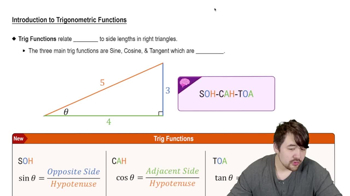
Introduction to Trigonometric Functions
Reciprocal Identities
Reciprocal identities are fundamental relationships in trigonometry that express one trigonometric function in terms of another. For example, the identity sec(θ) = 1/cos(θ) illustrates how the secant function is the reciprocal of the cosine function. Mastery of these identities is crucial for simplifying expressions and proving trigonometric identities.
Recommended video:
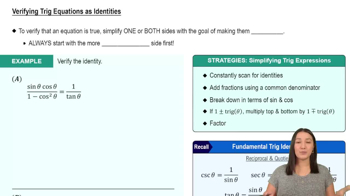
Verifying Trig Equations as Identities Example 4
Proving Trigonometric Identities
Proving trigonometric identities involves demonstrating that two expressions are equivalent using algebraic manipulation and known identities. This process often requires substituting one function for another, applying reciprocal identities, and simplifying the expressions. A solid grasp of trigonometric identities and properties is necessary to effectively prove these relationships.
Recommended video:
Verifying Trig Equations as Identities
Related Practice
Textbook Question
364
views
Textbook Question
{Use of Tech} Height and time The height in feet of a baseball hit straight up from the ground with an initial velocity of 64 ft/s is given by h= ƒ(t) = 64t - 16t² where t is measured in seconds after the hit.
e. At what time is the ball at a height of 10 ft on the way down?
253
views
Textbook Question
Find a trigonometric function represented by the graph in the figure. <IMAGE>
288
views
Textbook Question
Prove the following identities.
388
views
Textbook Question
{Use of Tech} Height and time The height in feet of a baseball hit straight up from the ground with an initial velocity of 64 ft/s is given by h= ƒ(t) = 64t - 16t² where t is measured in seconds after the hit.
d. At what time is the ball at a height of 30 ft on the way up?
257
views
Textbook Question
Changing bases Convert the following expressions to the indicated base.
using base 5
356
views