
Textbook Question
Composition of even and odd functions from tables Assume ƒ is an even function, g is an odd function, and both are defined at 0. Use the (incomplete) table to evaluate the given compositions. <IMAGE>
c. ƒ(g(-3))
322
views

 Verified step by step guidance
 06:21
06:21
 3:48
3:48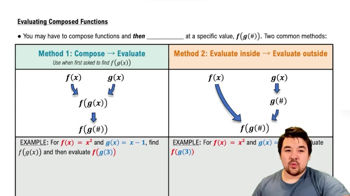 4:26
4:26Composition of even and odd functions from tables Assume ƒ is an even function, g is an odd function, and both are defined at 0. Use the (incomplete) table to evaluate the given compositions. <IMAGE>
c. ƒ(g(-3))
{Use of Tech} Sum of squared integers Let T (n) = 1² + 2² + ... + n², where n is a positive integer. It can be shown that T (n) = n (n + 1) (2n + 1) / 8
c. What is the least value of n for which T(n) > 1000?
Composition of even and odd functions from tables Assume ƒ is an even function, g is an odd function, and both are defined at 0. Use the (incomplete) table to evaluate the given compositions. <IMAGE>
i. g(g(g(-1)))
Composition of even and odd functions from tables Assume ƒ is an even function, g is an odd function, and both are defined at 0. Use the (incomplete) table to evaluate the given compositions. <IMAGE>
a. ƒ(g(-1))
Composition of even and odd functions from tables Assume ƒ is an even function, g is an odd function, and both are defined at 0. Use the (incomplete) table to evaluate the given compositions. <IMAGE>
e. g(g(-1))
Express in terms of using the inverse sine, inverse tangent, and inverse secant functions. <IMAGE>