

The height above the ground of a stone thrown upwards is given by s(t), where t is measured in seconds. After 1 second, the height of the stone is 48 feet above the ground, and after 1.5 seconds, the height of the stone is 60 feet above the ground. Evaluate s(1) and s(1.5), and then find the average velocity of the stone over the time interval [1, 1.5].
Ch. 2 - Limits
Briggs3rd EditionCalculus: Early TranscendentalsISBN: 9780136847243Not the one you use?Change textbook
Chapter 2, Problem 2.R.41
Determine the following limits.
lim x→∞ (3 tan-1 x + 2)
Verified step by step guidance1
Recognize that the problem involves finding the limit of a function as \( x \) approaches infinity: \( \lim_{x \to \infty} (3 \tan^{-1} x + 2) \).
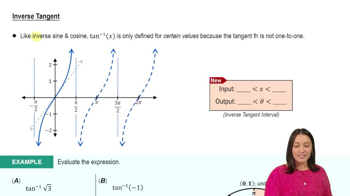
Recall the behavior of the inverse tangent function, \( \tan^{-1} x \), as \( x \to \infty \). The function approaches \( \frac{\pi}{2} \).
Substitute the asymptotic value of \( \tan^{-1} x \) into the expression: \( 3 \tan^{-1} x + 2 \approx 3 \left( \frac{\pi}{2} \right) + 2 \).
Simplify the expression by multiplying and adding the constants: \( 3 \times \frac{\pi}{2} + 2 \).
Conclude that the limit is the simplified expression from the previous step.

Verified video answer for a similar problem:
This video solution was recommended by our tutors as helpful for the problem above.
Video duration:
2mWas this helpful?
Key Concepts
Here are the essential concepts you must grasp in order to answer the question correctly.
Limits at Infinity
Limits at infinity involve evaluating the behavior of a function as the input approaches infinity. This concept is crucial for understanding how functions behave in extreme cases, allowing us to determine their end behavior. In this context, we analyze how the function approaches a specific value as x becomes very large.
Recommended video:
One-Sided Limits
Inverse Tangent Function
The inverse tangent function, denoted as tan<sup>-1</sup>(x) or arctan(x), is a function that returns the angle whose tangent is x. As x approaches infinity, the value of arctan(x) approaches π/2. This property is essential for solving the limit in the question, as it helps us understand the limiting behavior of the function involved.
Recommended video:
Inverse Tangent
Constant Addition in Limits
When evaluating limits, adding a constant to a function does not affect the limit itself. This principle allows us to simplify the limit calculation by focusing on the behavior of the variable part of the function. In this case, after determining the limit of the arctan function, we can simply add 2 to find the final limit value.
Recommended video:
One-Sided Limits
Related Practice
Textbook Question
251
views
Textbook Question
b. Estimate a solution to the equation in the given interval using a root finder.
x=cos x; (0,π/2)
215
views
Textbook Question
Find the intervals on which the following functions are continuous. Specify right- or left-continuity at the finite endpoints.
252
views
Textbook Question
Determine the following limits.
lim x→∞ (2x − 3) / (4x + 10)
395
views
Textbook Question
Use the graph of in the figure to determine the values of in the interval at which f fails to be continuous. Justify your answers using the continuity checklist.
<IMAGE>
314
views
Textbook Question
Let .
Determine values of the constants and , if possible, for which is continuous at .
361
views
