

Ch. 4 - Applications of the Derivative
Briggs - Calculus: Early Transcendentals 3rd Edition
Briggs3rd EditionCalculus: Early TranscendentalsISBN: 9780136847243Not the one you use?Change textbook
Chapter 4, Problem 4.7.19

Evaluate the following limits. Use l’Hôpital’s Rule when it is convenient and applicable.


lim_x→ 1 (x² + 2x) / (x +3)

Verified step by step guidance
1
First, substitute x = 1 into the expression (x² + 2x) / (x + 3) to check if the limit results in an indeterminate form like 0/0.
After substitution, if the expression results in 0/0, l'Hôpital's Rule can be applied. This rule states that for limits of the form 0/0 or ∞/∞, the limit of f(x)/g(x) as x approaches a value can be found by taking the limit of f'(x)/g'(x).
Differentiate the numerator f(x) = x² + 2x to get f'(x) = 2x + 2.
Differentiate the denominator g(x) = x + 3 to get g'(x) = 1.
Apply l'Hôpital's Rule by taking the limit of the new expression (2x + 2) / 1 as x approaches 1, and evaluate this limit.

Verified video answer for a similar problem:

This video solution was recommended by our tutors as helpful for the problem above.
Video duration:
1m
Was this helpful?

Key Concepts

Here are the essential concepts you must grasp in order to answer the question correctly.

Limits

A limit is a fundamental concept in calculus that describes the behavior of a function as its input approaches a certain value. It helps in understanding the function's value at points where it may not be explicitly defined. Evaluating limits is crucial for determining continuity, derivatives, and integrals.
Recommended video:
05:50
One-Sided Limits

l'Hôpital's Rule

l'Hôpital's Rule is a method used to evaluate limits that result in indeterminate forms, such as 0/0 or ∞/∞. It states that if the limit of f(x)/g(x) leads to an indeterminate form, the limit can be found by taking the derivative of the numerator and the derivative of the denominator separately, and then re-evaluating the limit.
Recommended video:

Continuous Functions

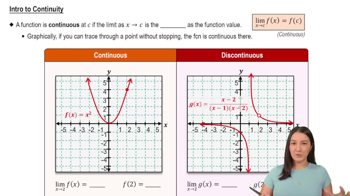
A function is continuous at a point if the limit of the function as it approaches that point equals the function's value at that point. Continuous functions do not have breaks, jumps, or holes, making them easier to analyze when evaluating limits. Understanding continuity is essential for applying l'Hôpital's Rule effectively.
Recommended video:
05:34
Intro to Continuity
Related Practice
Textbook Question

{Use of Tech} Special curves The following classical curves have been studied by generations of mathematicians. Use analytical methods (including implicit differentiation) and a graphing utility to graph the curves. Include as much detail as possible.


x³ + y³ = 3xy (Folium of Descartes)

162
views
Textbook Question

Differentials Consider the following functions and express the relationship between a small change in x and the corresponding change in y in the form dy = f'(x)dx.


f(x) = sin⁻¹ x

220
views
Textbook Question

Snell’s Law Suppose a light source at A is in a medium in which light travels at a speed v₁ and that point B is in a medium in which light travels at a speed v₂ (see figure). Using Fermat’s Principle, which states that light travels along the path that requires the minimum travel time (Exercise 55), show that the path taken between points A and B satisfies (sinΘ₁/v₁ = (sin Θ₂) /v₂ . <IMAGE>

291
views
Textbook Question

23–68. Indefinite integrals Determine the following indefinite integrals. Check your work by differentiation.


∫ (sec² x - 1) dx

90
views
Textbook Question

17–83. Limits Evaluate the following limits. Use l’Hôpital’s Rule when it is convenient and applicable.


lim_x→ 0 (eˣ - sin x - 1) / (x⁴ + 8x³ + 12x²)

292
views
Textbook Question

Second Derivative Test Locate the critical points of the following functions. Then use the Second Derivative Test to determine (if possible) whether they correspond to local maxima or local minima.


f(x) = eˣ(x - 2)²

186
views