Ch. 5 - Integration
Briggs - Calculus: Early Transcendentals 3rd Edition
Briggs3rd EditionCalculus: Early TranscendentalsISBN: 9780136847243Not the one you use?Change textbook
Chapter 5, Problem 5.R.1g

Explain why or why not Determine whether the following statements are true and give an explanation or counterexample. Assume Ζ’ and Ζ’' are continuous functions for all real numbers.
(g) ∫ Ζ’' (g(𝓍))g' (𝓍) d(𝓍) = Ζ’(g(𝓍)) + C .

Verified step by step guidance
1
Step 1: Recognize that the given integral ∫ Ζ’'(g(𝓍))g'(𝓍) d(𝓍) involves the chain rule in reverse. The chain rule states that if you have a composite function Ζ’(g(𝓍)), its derivative is Ζ’'(g(𝓍))g'(𝓍).
Step 2: Understand that the integral is asking to reverse the differentiation process. Since the derivative of Ζ’(g(𝓍)) is Ζ’'(g(𝓍))g'(𝓍), integrating Ζ’'(g(𝓍))g'(𝓍) with respect to 𝓍 should yield Ζ’(g(𝓍)) plus a constant of integration, C.
Step 3: Verify the conditions for this statement. The problem specifies that Ζ’ and Ζ’' are continuous functions for all real numbers, which ensures that the Fundamental Theorem of Calculus applies. This theorem guarantees that the integral of a derivative recovers the original function (up to a constant).
Step 4: Write the result formally. The integral ∫ Ζ’'(g(𝓍))g'(𝓍) d(𝓍) indeed equals Ζ’(g(𝓍)) + C, because the integrand matches the derivative of the composite function Ζ’(g(𝓍)).
Step 5: Conclude that the statement is true, and the explanation is rooted in the chain rule and the Fundamental Theorem of Calculus. No counterexample is needed because the conditions provided ensure the validity of the statement.

Verified video answer for a similar problem:

This video solution was recommended by our tutors as helpful for the problem above.
Video duration:
2m
Was this helpful?

Key Concepts

Here are the essential concepts you must grasp in order to answer the question correctly.

Fundamental Theorem of Calculus

The Fundamental Theorem of Calculus links the concept of differentiation and integration, stating that if a function is continuous on an interval, then the integral of its derivative over that interval gives the net change of the function. This theorem is crucial for understanding how integrals and derivatives are related, particularly in evaluating definite integrals and finding antiderivatives.
Recommended video:
06:11
Fundamental Theorem of Calculus Part 1

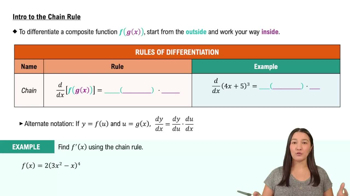
Chain Rule

The Chain Rule is a fundamental principle in calculus used to differentiate composite functions. It states that if a function is composed of two functions, the derivative of the outer function is multiplied by the derivative of the inner function. This rule is essential for evaluating integrals involving functions of functions, as seen in the statement provided.
Recommended video:
05:02
Intro to the Chain Rule

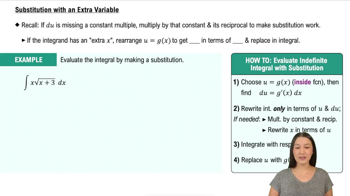
Integration by Substitution

Integration by substitution is a technique used to simplify the process of integration by changing the variable of integration. It involves substituting a part of the integrand with a new variable, which can make the integral easier to solve. This method is particularly relevant when dealing with integrals that involve composite functions, as it allows for a clearer path to finding the antiderivative.
Recommended video:
04:27
Substitution With an Extra Variable
Related Practice
Textbook Question

Evaluating integrals Evaluate the following integrals.                                                                                                                                         


 βˆ« sin 𝒡 sin (cos 𝒡) d𝒡

56
views
Textbook Question

Evaluating integrals Evaluate the following integrals.                                                                                                                                         


 βˆ« yΒ² /(yΒ³ + 27) dy

70
views
Textbook Question

Function defined by an integral Let H (𝓍) = βˆ«β‚€Λ£ √(4 ― tΒ²) dt, for ― 2 ≀ 𝓍 ≀ 2.

(c) Evaluate H '(2) .

83
views
Textbook Question

Area functions and the Fundamental Theorem Consider the function

Ζ’(t) = { t      if  β€•2 β‰€ t < 0

tΒ²/2    if    0 β‰€ t β‰€ 2

and its graph shown below. Let F(𝓍) = βˆ«β‚‹β‚Λ£ Ζ’(t) dt and G(𝓍) = βˆ«β‚‹β‚‚Λ£ Ζ’(t) dt.

(c) Use the Fundamental Theorem to find an expression for F '(𝓍) for 0 β‰€ π“ < 2.

57
views
Textbook Question

Evaluating integrals Evaluate the following integrals.


βˆ«β‚‹Ο€/β‚‚^Ο€/Β² (cos 2𝓍 + cos 𝓍 sin 𝓍 ― 3 sin 𝓍⁡) d𝓍

71
views
Textbook Question

Evaluating integrals Evaluate the following integrals.                                                                                                                                         


 βˆ« (cos 7Ο‰) /(16 + sinΒ² 7Ο‰) dΟ‰ 

71
views