
Textbook Question
41–44. {Use of Tech} Remainders and estimates Consider the following convergent series.
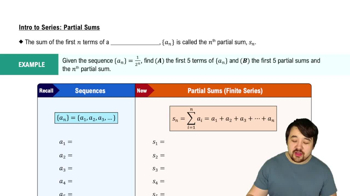
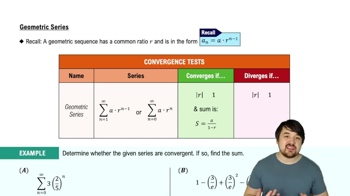
b. Find how many terms are needed to ensure that the remainder is less than 10⁻³.
43. ∑ (k = 1 to ∞) 1 / 3ᵏ
134
views

 Verified step by step guidance
 06:45
06:45
 06:00
06:00 10:07
10:0741–44. {Use of Tech} Remainders and estimates Consider the following convergent series.
b. Find how many terms are needed to ensure that the remainder is less than 10⁻³.
43. ∑ (k = 1 to ∞) 1 / 3ᵏ
27–34. Working with sequences Several terms of a sequence {aₙ}ₙ₌₁∞ are given.
b. Find a recurrence relation that generates the sequence (supply the initial value of the index and the first term of the sequence).
{1, 3, 9, 27, 81, ......}
Suppose the sequence {aₙ}⁽∞⁾ₙ₌₀ is defined by the recurrence relation
aₙ₊₁ = ⅓aₙ + 6;a₀ = 3.
b.Explain why {aₙ}⁽∞⁾ₙ₌₀ converges and find the limit.
Loglog p-series Consider the series ∑ (k = 2 to ∞) 1 / (k(ln k)(ln ln k)ᵖ), where p is a real number.
b. Which of the following series converges faster? Explain.
∑ (k = 2 to ∞) 1 / (k(ln k)²) or ∑ (k = 3 to ∞) 1 / (k(ln k)(ln ln k)²)?
72–75. {Use of Tech} Practical sequences
Consider the following situations that generate a sequence
b.Find an explicit formula for the terms of the sequence.
Drug elimination
Jack took a 200-mg dose of a pain killer at midnight. Every hour, 5% of the drug is washed out of his bloodstream. Let dₙ be the amount of drug in Jack’s blood n hours after the drug was taken, where d₀ = 200mg.
Explain why or why not Determine whether the following statements are true and give an explanation or counterexample.
b. A series that converges absolutely must converge.