
Ch.12 - Parametric and Polar Curves
Briggs - Calculus: Early Transcendentals 3rd Edition
Briggs3rd EditionCalculus: Early TranscendentalsISBN: 9780136847243Not the one you use?Change textbook
Chapter 12, Problem 12.R.4

3–6. Eliminating the parameter Eliminate the parameter to find a description of the following curves in terms of x and y. Give a geometric description and the positive orientation of the curve.
x = sin t - 3, y = cos t + 6; 0 ≤ t ≤ π

Verified step by step guidance
1
Identify the parametric equations given: \(x = \sin t - 3\) and \(y = \cos t + 6\), with the parameter \(t\) ranging from \(0\) to \(\pi\).
Recall the Pythagorean identity: \(\sin^2 t + \cos^2 t = 1\). This will help eliminate the parameter \(t\) by expressing \(x\) and \(y\) in terms of sine and cosine.
Express \(\sin t\) and \(\cos t\) in terms of \(x\) and \(y\): from \(x = \sin t - 3\), we get \(\sin t = x + 3\); from \(y = \cos t + 6\), we get \(\cos t = y - 6\).
Substitute these expressions into the Pythagorean identity: \((x + 3)^2 + (y - 6)^2 = 1\). This is the Cartesian equation of the curve.
Interpret the equation: it represents a circle centered at \((-3, 6)\) with radius \(1\). The parameter \(t\) from \(0\) to \(\pi\) corresponds to the upper half of the circle, and the positive orientation follows the direction of increasing \(t\) from \(0\) to \(\pi\).

Verified video answer for a similar problem:

This video solution was recommended by our tutors as helpful for the problem above.
Video duration:
2m
Was this helpful?

Key Concepts

Here are the essential concepts you must grasp in order to answer the question correctly.

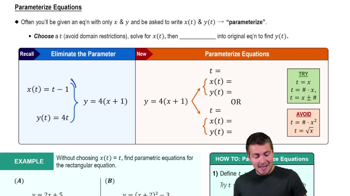
Parametric Equations

Parametric equations express the coordinates of points on a curve as functions of a parameter, often denoted t. Understanding how x and y depend on t allows us to describe the curve's path and behavior over the given interval.
Recommended video:
Guided course
08:02
Parameterizing Equations

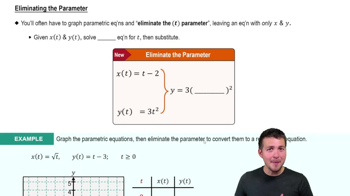
Eliminating the Parameter

Eliminating the parameter involves rewriting the parametric equations to form a single equation in x and y. This process often uses algebraic manipulation and trigonometric identities to remove t, yielding a Cartesian equation that describes the curve.
Recommended video:
Guided course
05:59
Eliminating the Parameter

Geometric Description and Orientation

After finding the Cartesian form, interpreting the curve geometrically involves identifying its shape (e.g., circle, ellipse) and position. Positive orientation refers to the direction in which the curve is traced as the parameter increases, important for understanding motion along the curve.
Recommended video:
Guided course
04:18
Geometric Sequences - Recursive Formula