Ch. 5 - Integration
Briggs - Calculus: Early Transcendentals 3rd Edition
Briggs3rd EditionCalculus: Early TranscendentalsISBN: 9780136847243Not the one you use?Change textbook
Chapter 5, Problem 5.5.116

Multiple substitutions If necessary, use two or more substitutions to find the following integrals.                                                                                    
                                                                                                                                                                    
  ∫ 𝓍 sin⁴ 𝓍² cos 𝓍² d𝓍 (Hint: Begin with u = 𝓍², and then use v = sin u .)

Verified step by step guidance
1
Start by identifying the first substitution as suggested: let \(u = x^{2}\). Then, compute the differential \(du = 2x \, dx\), which implies \(x \, dx = \frac{du}{2}\).
Rewrite the integral in terms of \(u\). Notice that \(\sin^{4}(x^{2}) = \sin^{4}(u)\) and \(\cos(x^{2}) = \cos(u)\). The integral becomes \(\int x \sin^{4}(x^{2}) \cos(x^{2}) \, dx = \int \sin^{4}(u) \cos(u) \cdot x \, dx = \int \sin^{4}(u) \cos(u) \cdot \frac{du}{2}\).
Simplify the integral to \(\frac{1}{2} \int \sin^{4}(u) \cos(u) \, du\). Now, observe that the integrand involves \(\sin^{4}(u)\) and \(\cos(u)\), which suggests a second substitution.
For the second substitution, let \(v = \sin(u)\). Then, \(dv = \cos(u) \, du\). This transforms the integral into \(\frac{1}{2} \int v^{4} \, dv\).
Now, the integral is a straightforward power integral in terms of \(v\). Integrate \(\frac{1}{2} \int v^{4} \, dv\) by increasing the power by one and dividing by the new exponent, then substitute back \(v = \sin(u)\) and \(u = x^{2}\) to express the answer in terms of \(x\).

Verified video answer for a similar problem:

This video solution was recommended by our tutors as helpful for the problem above.
Video duration:
2m
Was this helpful?

Key Concepts

Here are the essential concepts you must grasp in order to answer the question correctly.

Substitution Method in Integration

The substitution method simplifies integrals by changing variables to transform the integral into a more manageable form. It involves choosing a substitution u = g(x) such that the integral in terms of u is easier to evaluate. This technique is especially useful when the integral contains composite functions or products of functions.
Recommended video:
07:33
Euler's Method

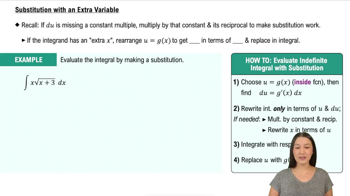
Multiple Substitutions

Multiple substitutions involve applying the substitution method more than once to solve complex integrals. After the first substitution simplifies part of the integral, a second substitution can further reduce it. This stepwise approach is essential when a single substitution does not fully simplify the integral.
Recommended video:
04:27
Substitution With an Extra Variable

Trigonometric Functions and Their Derivatives

Understanding the derivatives and integrals of trigonometric functions like sine and cosine is crucial. For example, knowing that the derivative of sin u is cos u helps in choosing substitutions and simplifying integrals involving powers of sine and cosine. This knowledge aids in recognizing patterns and applying substitutions effectively.
Recommended video:
06:35
Derivatives of Other Inverse Trigonometric Functions
Related Practice
Textbook Question

Definite integrals Evaluate the following integrals using the Fundamental Theorem of Calculus. Explain why your result is consistent with the figure.


∫₀¹ (𝓍² ― 2𝓍 + 3) d𝓍


132
views

Textbook Question

Limits of sums Use the definition of the definite integral to evaluate the following definite integrals. Use right Riemann sums and Theorem 5.1.


∫₀² (2𝓍 + 1) d𝓍

91
views
Textbook Question

Displacement from velocity The following functions describe the velocity of a car (in mi/hr) moving along a straight highway for a 3-hr interval. In each case, find the function that gives the displacement of the car over the interval [0,t], where 0 ≤ t ≤ 3.

v(t) = { 30 if 0 ≤ t ≤ 2

50 if 2 < t < 2.5

44 if 2.5 < t ≤ 3

98
views
Textbook Question

Indefinite integrals Use a change of variables or Table 5.6 to evaluate the following indefinite integrals. Check your work by differentiating.                                                                                  


 ∫ sec² (10𝓍 + 7) d𝓍

66
views
Textbook Question

Evaluate


lim [ ∫₂ˣ √(t² + t + 3dt) ] / (𝓍² ―4)

𝓍→2

45
views
Textbook Question

Definite integrals Evaluate the following integrals using the Fundamental Theorem of Calculus


∫₁² 3/t dt

95
views