

Ch. 6 - Applications of Integration
Briggs - Calculus: Early Transcendentals 3rd Edition
Briggs3rd EditionCalculus: Early TranscendentalsISBN: 9780136847243Not the one you use?Change textbook
Chapter 6, Problem 6.2.65c

Determine whether the following statements are true and give an explanation or counterexample.


c. ∫₀¹(x−x^2) dx=∫₀¹(√y−y) dy

Verified step by step guidance
1
Step 1: Begin by analyzing the given integral expressions. The first integral is ∫₀¹(x − x²) dx, which is in terms of x, and the second integral is ∫₀¹(√y − y) dy, which is in terms of y. To determine if these are equal, we need to explore whether a relationship exists between the two integrals.
Step 2: Recognize that the equality of these integrals might depend on a change of variables. Specifically, check if there is a substitution that transforms the integral in terms of x into the integral in terms of y. For example, consider the substitution y = x², which relates x and y.
Step 3: Apply the substitution y = x². If y = x², then dy = 2x dx. Also, note that when x ranges from 0 to 1, y will range from 0 to 1 as well. Substitute these relationships into the integral ∫₀¹(x − x²) dx to see if it matches the form of ∫₀¹(√y − y) dy.
Step 4: Rewrite the integral ∫₀¹(x − x²) dx using the substitution y = x². Replace x with √y and dx with dy/2x (or dy/(2√y)). Carefully simplify the resulting integral and compare it to ∫₀¹(√y − y) dy.
Step 5: Conclude whether the two integrals are equal based on the substitution and simplification. If the substitution leads to the second integral exactly, the statement is true. If not, provide a counterexample or explanation showing why the integrals differ.

Verified video answer for a similar problem:

This video solution was recommended by our tutors as helpful for the problem above.
Video duration:
3m
Was this helpful?

Key Concepts

Here are the essential concepts you must grasp in order to answer the question correctly.

Definite Integrals

A definite integral represents the signed area under a curve between two specified limits. It is denoted as ∫_a^b f(x) dx, where 'a' and 'b' are the lower and upper limits, respectively. The value of a definite integral can be computed using the Fundamental Theorem of Calculus, which connects differentiation and integration.
Recommended video:
05:43
Definition of the Definite Integral

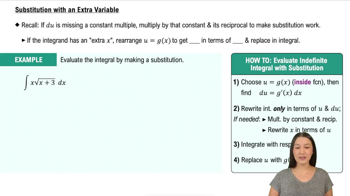
Substitution in Integration

Substitution is a technique used in integration to simplify the process by changing the variable of integration. This method involves replacing a variable with another variable that simplifies the integral, making it easier to evaluate. For example, if y = g(x), then dy = g'(x) dx, allowing the integral to be expressed in terms of y.
Recommended video:
04:27
Substitution With an Extra Variable

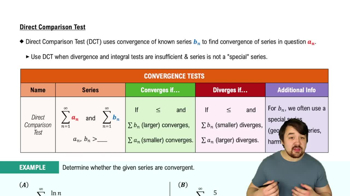
Comparison of Integrals

Comparing integrals involves evaluating whether two integrals yield the same value. This can be done by transforming one integral into another through substitution or by analyzing the functions involved. In the given statement, one must determine if the areas represented by the two integrals are equal, which may require evaluating both integrals separately.
Recommended video:
09:25
Direct Comparison Test
Related Practice
Textbook Question

A nonlinear spring Hooke’s law is applicable to idealized (linear) springs that are not stretched or compressed too far from their equilibrium positions. Consider a nonlinear spring whose restoring force is given by F(x) = 16x−0.1x³, for |x|≤7. 

c. How much work is done in compressing the spring from its equilibrium position (x=0) to x=−2?

89
views
Textbook Question

Determine whether the following statements are true and give an explanation or counterexample. 


c. Let f(x)=12x^2. The area of the surface generated when the graph of f on [−4, 4] is revolved about the x-axis is twice the area of the surface generated when the graph of f on [0, 4] is revolved about the x-axis. 

65
views
Textbook Question

Probe speed A data collection probe is dropped from a stationary balloon, and it falls with a velocity (in m/s) given by v(t) = 9.8t, neglecting air resistance. After 10 s, a chute deploys and the probe immediately slows to a constant speed of 10 m/s, which it maintains until it enters the ocean.


c. If the probe was released from an altitude of 3 km, when does it enter the ocean?

46
views
Textbook Question

Oscillating growth rates Some species have growth rates that oscillate with an (approximately) constant period P. Consider the growth rate function N'(t) = r+A sin 2πt/P, where A and r are constants with units of individuals/yr, and t is measured in years. A species becomes extinct if its population ever reaches 0 after t=0.


c. Suppose P=10, A=50, and r=5. If the initial population is N(0)=10, does the population ever become extinct? Explain.

42
views
Textbook Question

13–16. Displacement from velocity Consider an object moving along a line with the given velocity v. Assume time t is measured in seconds and velocities have units of m/s.


c. Find the distance traveled over the given interval.


v(t) = 4t³ - 24t²+20t on [0, 5]

67
views
Textbook Question

Flow rates in the Spokane River The daily discharge of the Spokane River as it flows through Spokane, Washington, in April and June is modeled by the functions

r1(t) = 0.25t²+37.46t+722.47 (April) and

r2(t) = 0.90t²−69.06t+2053.12 (June), where the discharge is measured in millions of cubic feet per day, and t=0 corresponds to the beginning of the first day of the month (see figure).

c. The Spokane River flows out of Lake Coeur d’Alene, which contains approximately 0.67mi³ of water. Determine the percentage of Lake Coeur d’Alene’s volume that flows through Spokane in April and June.

32
views