Ch. 2 - Limits
Briggs - Calculus: Early Transcendentals 3rd Edition
Briggs3rd EditionCalculus: Early TranscendentalsISBN: 9780136847243Not the one you use?Change textbook
Chapter 2, Problem 2.41

Estimate the following limits using graphs or tables.
limh0ln(1+h)h{\(\displaystyle\]\lim\)_{h\(\to\)0}}\(\frac{\ln\left(1+h\right)}{h}\)

Verified step by step guidance
1
Recognize that the limit \( \lim_{h \to 0} \frac{\ln(1+h)}{h} \) is a standard limit that can be evaluated using the definition of the derivative.
Identify that the expression \( \frac{\ln(1+h)}{h} \) resembles the difference quotient for the derivative of \( \ln(x) \) at \( x = 1 \).
Recall that the derivative of \( \ln(x) \) is \( \frac{1}{x} \). Therefore, at \( x = 1 \), the derivative is \( \frac{1}{1} = 1 \).
Conclude that the limit \( \lim_{h \to 0} \frac{\ln(1+h)}{h} \) is equal to the derivative of \( \ln(x) \) at \( x = 1 \), which is 1.
Alternatively, use L'Hôpital's Rule, which applies to limits of the form \( \frac{0}{0} \), by differentiating the numerator and the denominator separately and then taking the limit.

Verified video answer for a similar problem:

This video solution was recommended by our tutors as helpful for the problem above.
Video duration:
4m
Was this helpful?

Key Concepts

Here are the essential concepts you must grasp in order to answer the question correctly.

Limits

Limits are fundamental in calculus, representing the value that a function approaches as the input approaches a certain point. In this context, we are interested in the limit of the function ln(1+h)/h as h approaches 0. Understanding limits is crucial for analyzing the behavior of functions near specific points, especially when direct substitution may lead to indeterminate forms.
Recommended video:
05:50
One-Sided Limits

Natural Logarithm

The natural logarithm, denoted as ln(x), is the logarithm to the base e, where e is approximately 2.71828. It is a key function in calculus, particularly in relation to growth rates and areas under curves. In the limit expression given, ln(1+h) captures the behavior of logarithmic growth as h approaches 0, which is essential for evaluating the limit.
Recommended video:
05:18
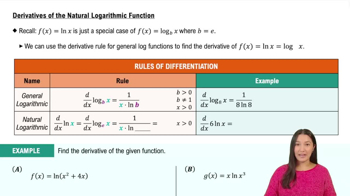
Derivative of the Natural Logarithmic Function

L'Hôpital's Rule

L'Hôpital's Rule is a method for evaluating limits of indeterminate forms, such as 0/0 or ∞/∞. It states that if the limit of f(x)/g(x) results in an indeterminate form, the limit can be found by taking the derivative of the numerator and the derivative of the denominator. This rule can be applied to the limit in the question, allowing for a more straightforward evaluation of the limit as h approaches 0.
Recommended video:
Related Practice
Textbook Question

Determine limxf(x)\(\lim\)_{x\(\rightarrow\]\infty\)}f\(\left\)(x\(\right\)) and limxf(x)\(\lim\)_{x\(\rightarrow\)-\(\infty\)}f\(\left\)(x\(\right\)) for the following functions. Then give the horizontal asymptotes of ff (if any).


f(x)=4x(3x9x2+1)f\(\left\)(x\(\right\))=4x\(\left\)(3x-\(\sqrt{9x^2+1}\]\right\))

348
views
Textbook Question

Determine limxf(x)\(\lim\)_{x\(\rightarrow\]\infty\)}f\(\left\)(x\(\right\)) and limxf(x)\(\lim\)_{x\(\rightarrow\)-\(\infty\)}f\(\left\)(x\(\right\)) for the following functions. Then give the horizontal asymptotes of ff (if any).


f(x)=6x29x+83x2+2f\(\left\)(x\(\right\))=\(\frac{6x^2-9x+8}{3x^2+2}\)

391
views
Textbook Question

Sketch a possible graph of a function f that satisfies all of the given conditions. Be sure to identify all vertical and horizontal asymptotes.

f(1)=2f\(\left\)(-1\(\right\))=-2, f(1)=2f\(\left\)(1\(\right\))=2, f(0)=0f\(\left\)(0\(\right\))=0, limxf(x)=1{\(\displaystyle\[\lim\)_{x\(\to\]\infty\)}{f(x)=1}}, limxf(x)=1{\(\displaystyle\]\lim\)_{x\(\to\)-\(\infty\)}{f(x)=-1}}

521
views
Textbook Question

Consider the position function s(t) =−16t^2+100t representing the position of an object moving vertically along a line. Sketch a graph of s with the secant line passing through (0.5, s(0.5)) and (2, s(2)). Determine the slope of the secant line and explain its relationship to the moving object.

370
views
Textbook Question

Use analytical methods and/or a graphing utility to identify the vertical asymptotes (if any) of the following functions.

f(x)=1/ √x sec x

263
views
Textbook Question

Use an appropriate limit definition to prove the following limits.


lim x→ 5x^2 − 25 / x − 5=10

386
views