Ch. 3 - Derivatives
Briggs - Calculus: Early Transcendentals 3rd Edition
Briggs3rd EditionCalculus: Early TranscendentalsISBN: 9780136847243Not the one you use?Change textbook
Chapter 3, Problem 19c

Suppose the position of an object moving horizontally along a line after t seconds is given by the following functions s = f(t), where s is measured in feet, with s > 0 corresponding to positions right of the origin.
Determine the velocity and acceleration of the object at t = 1. 
f(t) = 2t3 - 21t2 + 60t; 0 ≤ t ≤ 6

Verified step by step guidance
1
Step 1: Understand that the velocity of an object is the derivative of its position function with respect to time. Therefore, to find the velocity function v(t), differentiate the position function f(t) = 2t^3 - 21t^2 + 60t with respect to t.
Step 2: Apply the power rule of differentiation to find the derivative of each term in f(t). The power rule states that d/dt [t^n] = n*t^(n-1).
Step 3: Differentiate the first term: d/dt [2t^3] = 3*2*t^(3-1) = 6t^2.
Step 4: Differentiate the second term: d/dt [-21t^2] = 2*(-21)*t^(2-1) = -42t.
Step 5: Differentiate the third term: d/dt [60t] = 60, since the derivative of t with respect to t is 1. Combine these results to get the velocity function v(t) = 6t^2 - 42t + 60.

Verified video answer for a similar problem:

This video solution was recommended by our tutors as helpful for the problem above.
Video duration:
5m
Was this helpful?

Key Concepts

Here are the essential concepts you must grasp in order to answer the question correctly.

Position Function

The position function, denoted as s = f(t), describes the location of an object at any given time t. In this case, the function f(t) = 2t³ - 21t² + 60t provides a mathematical representation of the object's position in feet as a function of time in seconds. Understanding this function is crucial for determining the object's velocity and acceleration.
Recommended video:
5:20
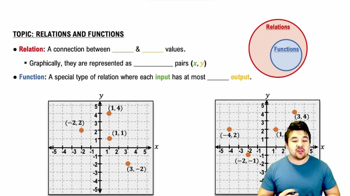
Relations and Functions

Velocity

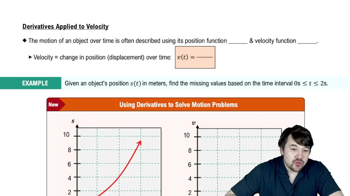
Velocity is the rate of change of position with respect to time, mathematically represented as the first derivative of the position function, v(t) = f'(t). For the given function, calculating the derivative will yield the velocity at any time t, including t = 1. This concept is essential for understanding how fast the object is moving at a specific moment.
Recommended video:
06:29
Derivatives Applied To Velocity

Acceleration

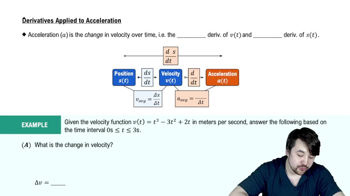
Acceleration is the rate of change of velocity with respect to time, represented as the second derivative of the position function, a(t) = f''(t). By finding the second derivative of the position function, we can determine the object's acceleration at any time, including t = 1. This concept helps in understanding how the object's velocity is changing over time.
Recommended video:
06:15
Derivatives Applied To Acceleration
Related Practice
Textbook Question

5–24. For each of the following composite functions, find an inner function u=g(x) and an outer function y=f(u) such that y=f(g(x)). Then calculate dy/dx.

y = √7x-1

258
views

Textbook Question

Use definition (1) (p. 133) to find the slope of the line tangent to the graph of f at P.

f(x) = √(3x + 3); P(2,3)

245
views
Textbook Question

5–24. For each of the following composite functions, find an inner function u=g(x) and an outer function y=f(u) such that y=f(g(x)). Then calculate dy/dx.

y = √x²+1

237
views
Textbook Question

Suppose the position of an object moving horizontally along a line after t seconds is given by the following functions s = f(t), where s is measured in feet, with s > 0 corresponding to positions right of the origin.

On what intervals is the speed increasing?

f(t) = 18t - 3t2; 0 ≤ t ≤ 8

230
views
Textbook Question

Suppose the position of an object moving horizontally along a line after t seconds is given by the following functions s = f(t), where s is measured in feet, with s > 0 corresponding to positions right of the origin.

On what intervals is the speed increasing?

f(t) = 6t3 + 36t2 - 54t; 0 ≤ t ≤ 4

199
views
Textbook Question

Position, velocity, and acceleration Suppose the position of an object moving horizontally along a line after t seconds is given by the following functions s = f(t), where s is measured in feet, with s > 0 corresponding to positions right of the origin.

a. Graph the position function.

f(t)=6t3+36t254t;0t4f(t)=6t^3+36t^2-54t;0\(\le\) t\(\le\)4

349
views