Ch. 3 - Derivatives
Briggs - Calculus: Early Transcendentals 3rd Edition
Briggs3rd EditionCalculus: Early TranscendentalsISBN: 9780136847243Not the one you use?Change textbook
Chapter 3, Problem 3.8.82a

79–82. {Use of Tech} Visualizing tangent and normal lines <IMAGE>
a. Determine an equation of the tangent line and the normal line at the given point (x0, y0) on the following curves. (See instructions for Exercises 73–78.)
(x²+y²)² = 25/3 (x²-y²); (x0,y0) = (2,-1) (lemniscate of Bernoulli)

Verified step by step guidance
1
First, understand the problem: We need to find the equations of the tangent and normal lines to the curve at a specific point. The curve is given by the equation \((x^2 + y^2)^2 = \frac{25}{3}(x^2 - y^2)\), and the point is \((x_0, y_0) = (2, -1)\).
To find the tangent line, we need the derivative of the curve at the point \((2, -1)\). Start by differentiating the given equation implicitly with respect to \(x\). This involves using the chain rule and implicit differentiation techniques.
After differentiating, substitute \(x = 2\) and \(y = -1\) into the derivative to find the slope \(m\) of the tangent line at the point \((2, -1)\).
Use the point-slope form of the equation of a line, \(y - y_0 = m(x - x_0)\), to write the equation of the tangent line. Here, \(m\) is the slope found in the previous step, and \((x_0, y_0)\) is \((2, -1)\).
The normal line is perpendicular to the tangent line. Therefore, its slope is the negative reciprocal of the tangent line's slope. Use the point-slope form again with this new slope to write the equation of the normal line at the point \((2, -1)\).

Verified video answer for a similar problem:

This video solution was recommended by our tutors as helpful for the problem above.
Video duration:
12m
Was this helpful?

Key Concepts

Here are the essential concepts you must grasp in order to answer the question correctly.

Tangent Line

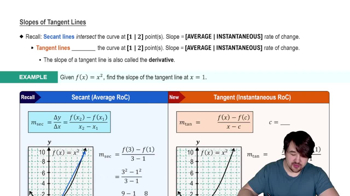
A tangent line to a curve at a given point is a straight line that touches the curve at that point without crossing it. The slope of the tangent line is equal to the derivative of the function at that point, which represents the instantaneous rate of change of the function. To find the equation of the tangent line, one typically uses the point-slope form of a line, incorporating the slope derived from the derivative.
Recommended video:
05:13
Slopes of Tangent Lines

Normal Line

The normal line at a point on a curve is perpendicular to the tangent line at that same point. Its slope is the negative reciprocal of the slope of the tangent line. To find the equation of the normal line, one can use the point-slope form as well, substituting the point coordinates and the normal slope. This line represents the direction in which the curve is not changing at that point.
Recommended video:
05:13
Slopes of Tangent Lines

Implicit Differentiation

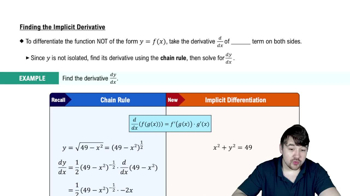
Implicit differentiation is a technique used to differentiate equations where the dependent and independent variables are not explicitly separated. In cases like the given curve, where y is not isolated, one differentiates both sides of the equation with respect to x, applying the chain rule as necessary. This method allows for finding the derivative of y with respect to x, which is essential for determining the slopes of the tangent and normal lines.
Recommended video:
05:14
Finding The Implicit Derivative