Ch. 8 - Integration Techniques
Briggs - Calculus: Early Transcendentals 3rd Edition
Briggs3rd EditionCalculus: Early TranscendentalsISBN: 9780136847243Not the one you use?Change textbook
Chapter 8, Problem 8.R.92

92. Integral with a parameter For what values of p does the integral
∫ (from 1 to ∞) dx/xlnᵖ(x) converge, and what is its value (in terms of p)?

Verified step by step guidance
1
First, rewrite the integral to clearly identify the integrand and the limits: consider the integral \( \int_1^{\infty} \frac{1}{x (\ln x)^p} \, dx \).
To analyze convergence, perform the substitution \( t = \ln x \). Then, \( dt = \frac{1}{x} dx \), which implies \( dx = x \, dt \). Substitute into the integral:
\[ \int_1^{\infty} \frac{1}{x (\ln x)^p} \, dx = \int_0^{\infty} \frac{1}{t^p} \, dt \]
Now, examine the integral \( \int_0^{\infty} t^{-p} \, dt \) for convergence. Since the integral is improper at both limits, analyze the behavior near 0 and near infinity separately:
- Near \( t = 0 \), the integral \( \int_0^1 t^{-p} \, dt \) converges if and only if \( p < 1 \).
- Near \( t = \infty \), the integral \( \int_1^{\infty} t^{-p} \, dt \) converges if and only if \( p > 1 \).
Since both conditions cannot be true simultaneously, the integral converges only if \( p > 1 \) because the original integral's lower limit corresponds to \( t = 0 \) and the upper limit to \( t = \infty \). Actually, the substitution shows the lower limit is \( t=0 \), so we must be careful: the integral converges if \( p > 1 \) because the integral near infinity converges only then, and near zero the integral converges for \( p < 1 \), but since the lower limit is 0, the integral diverges there if \( p \geq 1 \).
Finally, for \( p > 1 \), compute the value of the integral by evaluating \( \int_0^{\infty} t^{-p} \, dt \) with proper limits and express the result in terms of \( p \).

Verified video answer for a similar problem:

This video solution was recommended by our tutors as helpful for the problem above.
Video duration:
4m
Was this helpful?

Key Concepts

Here are the essential concepts you must grasp in order to answer the question correctly.

Improper Integrals and Convergence

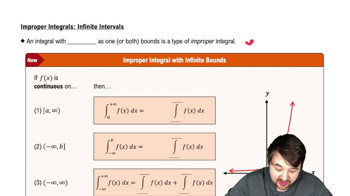
Improper integrals involve integration over infinite intervals or integrands with unbounded behavior. To determine convergence, one must analyze the limit of the integral as the upper bound approaches infinity. If this limit exists and is finite, the integral converges; otherwise, it diverges.
Recommended video:
11:11
Improper Integrals: Infinite Intervals

Behavior of the Integrand Near Infinity

Understanding how the function behaves as x approaches infinity is crucial. For the integral ∫₁^∞ dx / (x ln^p(x)), the decay rate of the denominator, especially the power p on the logarithm, determines whether the integral converges. Slower decay (small p) may lead to divergence, while faster decay (larger p) can ensure convergence.
Recommended video:
05:22
Completing the Square to Rewrite the Integrand

Use of Substitution in Evaluating Integrals

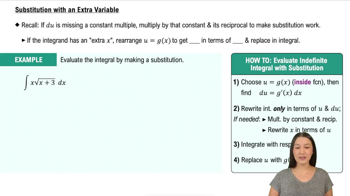
Substitution simplifies integrals by changing variables to a more manageable form. For this integral, substituting t = ln(x) transforms the integral into one involving t, making it easier to analyze convergence and compute the integral's value in terms of p.
Recommended video:
04:27
Substitution With an Extra Variable