
Textbook Question
Working with area functions Consider the function ƒ and the points a, b, and c.
(b) Graph ƒ and A.
ƒ(𝓍) = eˣ ; a = 0 , b = ln 2 , c = ln 4
50
views

 Verified step by step guidance
 06:11
06:11
 05:43
05:43 5:46
5:46Working with area functions Consider the function ƒ and the points a, b, and c.
(b) Graph ƒ and A.
ƒ(𝓍) = eˣ ; a = 0 , b = ln 2 , c = ln 4
{Use of Tech} Functions defined by integrals Consider the function g, which is given in terms of a definite integral with a variable upper limit.
b) Calculate g'(𝓍)
g(𝓍) = ∫₀ˣ sin² t dt
Explain why or why not Determine whether the following statements are true and give an explanation or counterexample.
(b) Suppose ƒ is a negative increasing function, for 𝓍 > 0 . Then the area function A(𝓍) = ∫₀ˣ ƒ(t) dt is a decreasing function of 𝓍 .
Explain why or why not Determine whether the following statements are true and give an explanation or counterexample.
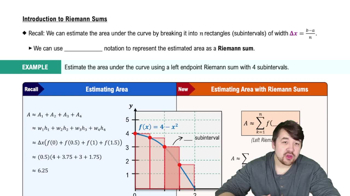
(b) A left Riemann sum always overestimates the area of a region bounded by a positive increasing function and the x-axis on an interval [a,b].
Sigma notation Express the following sums using sigma notation. (Answers are not unique.)
(b) 4 + 5 + 6 + 7 + 8 + 9
Mass from density A thin 10-cm rod is made of an alloy whose density varies along its length according to the function shown in the figure. Assume density is measured in units of g/cm. In Chapter 6, we show that the mass of the rod is the area under the density curve.
(b) Find the mass of the right half of the rod (5 ≤ x ≤ 10) .