Ch. 3 - Derivatives
Briggs - Calculus: Early Transcendentals 3rd Edition
Briggs3rd EditionCalculus: Early TranscendentalsISBN: 9780136847243Not the one you use?Change textbook
Chapter 3, Problem 77b

For x < 0, what is f′(x)?

Verified step by step guidance
1
Step 1: Identify the function f(x) for which you need to find the derivative f'(x). Without the explicit form of f(x), we cannot proceed with differentiation.
Step 2: Once you have the function f(x), apply the rules of differentiation. Common rules include the power rule, product rule, quotient rule, and chain rule.
Step 3: If f(x) is a polynomial, use the power rule: for any term ax^n, the derivative is anx^(n-1).
Step 4: If f(x) involves trigonometric, exponential, or logarithmic functions, use the respective differentiation rules for these functions.
Step 5: After applying the appropriate rules, simplify the expression to find f'(x) for x < 0.

Verified video answer for a similar problem:

This video solution was recommended by our tutors as helpful for the problem above.
Video duration:
4m
Was this helpful?

Key Concepts

Here are the essential concepts you must grasp in order to answer the question correctly.

Derivative

The derivative of a function measures the rate at which the function's value changes as its input changes. It is defined as the limit of the average rate of change of the function over an interval as the interval approaches zero. In this context, f′(x) represents the derivative of the function f at the point x, indicating the slope of the tangent line to the graph of f at that point.
Recommended video:
05:44
Derivatives

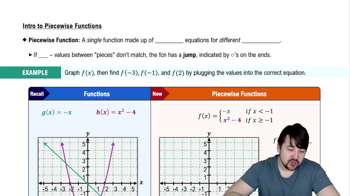
Piecewise Functions

A piecewise function is defined by different expressions based on the input value. For example, a function may have one formula for x < 0 and another for x ≥ 0. Understanding how to evaluate the derivative of a piecewise function requires knowing which expression to use for the given value of x, particularly when x is negative in this case.
Recommended video:
05:36
Piecewise Functions

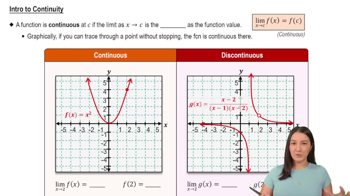
Continuity and Differentiability

For a function to be differentiable at a point, it must be continuous at that point. This means there should be no breaks, jumps, or holes in the function's graph. When analyzing f′(x) for x < 0, it is essential to ensure that the function f is continuous in that interval, as any discontinuity could affect the existence of the derivative at those points.
Recommended video:
05:34
Intro to Continuity