Ch. 3 - Derivatives
Briggs - Calculus: Early Transcendentals 3rd Edition
Briggs3rd EditionCalculus: Early TranscendentalsISBN: 9780136847243Not the one you use?Change textbook
Chapter 3, Problem 3.9.5

State the derivative rule for the logarithmic function f(x)=log(subscript b)x. How does it differ from the derivative formula for ln x?

Verified step by step guidance
1
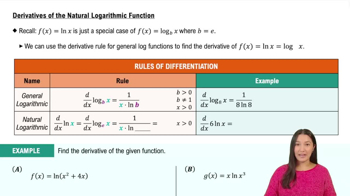
The derivative of the logarithmic function \( f(x) = \log_b{x} \) is given by the formula \( f'(x) = \frac{1}{x \ln{b}} \). This formula is derived using the change of base formula for logarithms and the chain rule.
To understand this, recall the change of base formula: \( \log_b{x} = \frac{\ln{x}}{\ln{b}} \). This allows us to express the logarithm in terms of the natural logarithm, \( \ln{x} \).
Differentiate \( \frac{\ln{x}}{\ln{b}} \) with respect to \( x \). Since \( \ln{b} \) is a constant, the derivative is \( \frac{1}{\ln{b}} \cdot \frac{d}{dx}(\ln{x}) \).
The derivative of \( \ln{x} \) with respect to \( x \) is \( \frac{1}{x} \). Therefore, the derivative of \( \log_b{x} \) becomes \( \frac{1}{x \ln{b}} \).
In contrast, the derivative of \( \ln{x} \) is simply \( \frac{1}{x} \). The difference arises from the presence of the constant \( \ln{b} \) in the denominator for the derivative of \( \log_b{x} \).

Verified video answer for a similar problem:

This video solution was recommended by our tutors as helpful for the problem above.
Video duration:
1m
Was this helpful?

Key Concepts

Here are the essential concepts you must grasp in order to answer the question correctly.

Derivative of Logarithmic Functions

The derivative of the logarithmic function f(x) = log_b(x) is given by f'(x) = 1 / (x ln(b)), where b is the base of the logarithm. This rule highlights how the derivative depends on both the input x and the natural logarithm of the base b, indicating that the rate of change of the logarithmic function varies with different bases.
Recommended video:
05:18
Derivative of the Natural Logarithmic Function

Natural Logarithm

The natural logarithm, denoted as ln(x), is a specific logarithmic function where the base is Euler's number e (approximately 2.718). The derivative of ln(x) is simpler, given by f'(x) = 1/x, which reflects the unique properties of the natural logarithm and its relationship to exponential functions.
Recommended video:
05:18
Derivative of the Natural Logarithmic Function

Comparison of Derivative Rules

The key difference between the derivatives of log_b(x) and ln(x) lies in the presence of the base b in the former's derivative formula. While ln(x) has a straightforward derivative of 1/x, log_b(x) introduces an additional factor of 1/ln(b), making it essential to consider the base when differentiating logarithmic functions with bases other than e.
Recommended video: