
11–86. Applying convergence tests Determine whether the following series converge. Justify your answers. ∑ (from k = 0 to ∞) (3ᵏ⁺⁴) / (5ᵏ⁻²)
Verified step by step guidance
1
Rewrite the general term of the series to simplify the expression. The term is given by \(\frac{3^{k+4}}{5^{k-2}}\). Use the properties of exponents to separate the powers of constants and the variable \(k\): \(\frac{3^{k} \cdot 3^{4}}{5^{k} \cdot 5^{-2}} = 3^{4} \cdot 5^{2} \cdot \frac{3^{k}}{5^{k}}\).
Simplify the term further by combining the powers with the same base in the numerator and denominator: \(3^{4} \cdot 5^{2} \cdot \left(\frac{3}{5}\right)^{k}\). This shows the term is a constant multiplied by a geometric term \(\left(\frac{3}{5}\right)^{k}\).
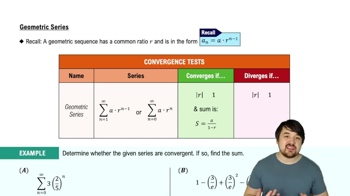
Recognize that the series is a geometric series of the form \(\sum_{k=0}^{\infty} ar^{k}\) where \(a = 3^{4} \cdot 5^{2}\) and \(r = \frac{3}{5}\). Recall that a geometric series converges if and only if \(|r| < 1\).
Check the value of the common ratio \(r = \frac{3}{5}\). Since \(\frac{3}{5} = 0.6\) and \$0.6 < 1$, the geometric series converges.
Conclude that the original series converges by the geometric series test because the common ratio's absolute value is less than 1.
Verified video answer for a similar problem:
This video solution was recommended by our tutors as helpful for the problem above
Video duration:
3m
Play a video:
0 Comments
Key Concepts
Here are the essential concepts you must grasp in order to answer the question correctly.
Infinite Series and Convergence
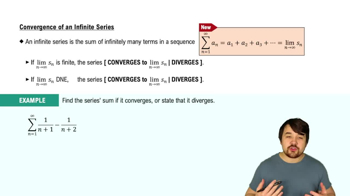
An infinite series is the sum of infinitely many terms. Determining convergence means checking if the sum approaches a finite limit as the number of terms grows indefinitely. Understanding the behavior of the series terms is essential to decide if the series converges or diverges.
A geometric series has terms that are multiples of a constant ratio raised to increasing powers. It converges if the absolute value of the common ratio is less than one, and its sum can be found using a specific formula. Recognizing a series as geometric simplifies the convergence test.
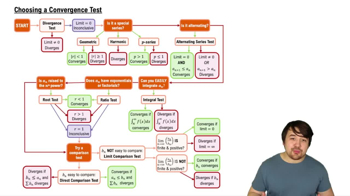
Various tests, such as the Ratio Test or Root Test, help determine if a series converges. These tests analyze the limit of the ratio or root of successive terms. Applying the appropriate test provides a rigorous justification for convergence or divergence.