
Ch. 3 - Derivatives
Hass - Thomas' Calculus 15th Edition
Hass15th EditionThomas' CalculusISBN: 9780137616077Not the one you use?Change textbook
Chapter 3, Problem 3.2.50a

Differentiability and Continuity on an Interval


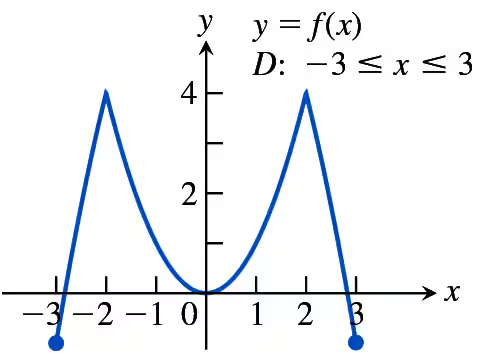
Each figure in Exercises 45–50 shows the graph of a function over a closed interval D. At what domain points does the function appear to be


a. differentiable?


Give reasons for your answers.


Graph of a function with labeled axes, showing a closed interval from -3 to 3, highlighting points of differentiability.

Verified step by step guidance
1
Examine the graph of the function over the interval D: [-3, 3]. Look for points where the graph has sharp corners or cusps, as these are typically points where the function is not differentiable.
Identify any points where the graph has vertical tangents or discontinuities. These are also points where the function is not differentiable.
Check the endpoints of the interval, x = -3 and x = 3. Differentiability at endpoints requires one-sided derivatives to exist and be equal, which is often not the case.
Observe the smoothness of the graph between the points -3 and 3. If the graph is smooth and continuous without any sharp turns, the function is likely differentiable at those points.
Conclude that the function appears to be differentiable at points where the graph is smooth and continuous, excluding any sharp corners, cusps, or endpoints where differentiability is not guaranteed.

Verified video answer for a similar problem:

This video solution was recommended by our tutors as helpful for the problem above.
Video duration:
3m
Was this helpful?

Key Concepts

Here are the essential concepts you must grasp in order to answer the question correctly.

Differentiability

A function is differentiable at a point if it has a defined derivative at that point, meaning the function's graph has a tangent line that is not vertical. This requires the function to be smooth and continuous at that point, without any sharp corners or cusps. If a function is not differentiable at a point, it may be due to discontinuities or abrupt changes in direction.
Recommended video:
05:53
Finding Differentials

Continuity

A function is continuous at a point if the limit of the function as it approaches that point equals the function's value at that point. This means there are no breaks, jumps, or holes in the graph at that point. For a function to be differentiable at a point, it must first be continuous there; however, continuity alone does not guarantee differentiability.
Recommended video:
05:34
Intro to Continuity

Closed Interval

A closed interval, denoted as [a, b], includes all the numbers between a and b, including the endpoints a and b themselves. In the context of differentiability and continuity, analyzing a function over a closed interval allows us to evaluate its behavior at the endpoints and within the interval. This is crucial for determining where the function is differentiable or continuous.
Recommended video:
11:11
Improper Integrals: Infinite Intervals