Ch. 7 - Logarithmic, Exponential Functions, and Hyperbolic Functions
Briggs - Calculus: Early Transcendentals 3rd Edition
Briggs3rd EditionCalculus: Early TranscendentalsISBN: 9780136847243Not the one you use?Change textbook
Chapter 7, Problem 7.2.39

39–40. LED lighting LED (light-emitting diode) bulbs are rapidly decreasing in cost, and they are more energy-efficient than standard incandescent light bulbs and CFL (compact fluorescent light) bulbs. By some estimates, LED bulbs last more than 40 times longer than incandescent bulbs and more than 8 times longer than CFL bulbs. Haitz’s law, which is explored in the following two exercises, predicts that over time, LED bulbs will exponentially increase in efficiency and exponentially decrease in cost.


Haitz’s law predicts that the cost per lumen of an LED bulb decreases by a factor of 10 every 10 years. This means that 10 years from now, the cost of an LED bulb will be 1/10 of its current cost. Predict the cost of a particular LED bulb in 2021 if it costs 4 dollars in 2018.

Verified step by step guidance
1
Identify the type of change described: The problem states that the cost decreases by a factor of 10 every 10 years, which indicates an exponential decay model.
Set up the exponential decay formula for cost: Let \(C(t)\) represent the cost at time \(t\) years, and \(C_0\) be the initial cost. The formula is \(C(t) = C_0 \times a^{\frac{t}{T}}\), where \(a\) is the decay factor and \(T\) is the time period for one decay step.
Assign the known values: The initial cost \(C_0\) is 4 dollars in 2018, the decay factor \(a\) is \(\frac{1}{10}\) (since cost decreases by a factor of 10), and the time period \(T\) is 10 years.
Calculate the time difference \(t\) between 2018 and 2021: \(t = 2021 - 2018 = 3\) years.
Substitute all values into the formula to express the cost in 2021: \(C(3) = 4 \times \left(\frac{1}{10}\right)^{\frac{3}{10}}\). This expression represents the predicted cost in 2021.

Verified video answer for a similar problem:

This video solution was recommended by our tutors as helpful for the problem above.
Video duration:
5m
Was this helpful?

Key Concepts

Here are the essential concepts you must grasp in order to answer the question correctly.

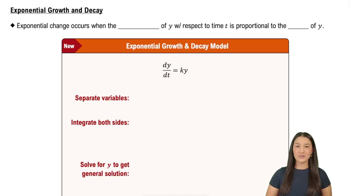
Exponential Decay

Exponential decay describes a process where a quantity decreases by a consistent factor over equal time intervals. In this problem, the cost per lumen of an LED bulb decreases by a factor of 10 every 10 years, meaning the cost reduces to one-tenth of its previous value after each decade.
Recommended video:
09:29
Exponential Growth & Decay

Haitz’s Law

Haitz’s law is an empirical observation that LED technology improves exponentially over time, with efficiency increasing and cost decreasing by fixed factors every decade. This law helps predict future costs and efficiencies of LED bulbs based on current data.
Recommended video:
10:44
Newton's Law of Cooling

Time Interval and Proportionality in Exponential Models

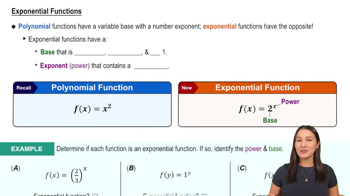
Understanding how to apply exponential decay over non-integer time intervals is essential. Since the problem asks for the cost in 2021, which is 3 years after 2018, you must calculate the decay proportionally for 3 years, not a full 10-year period, using fractional exponents.
Recommended video:
6:13
Exponential Functions