Population of Texas Texas was the third fastest growing state in the United States in 2016. Texas grew from 25.1 million in 2010 to 26.47 million in 2016. Use an exponential growth model to predict the population of Texas in 2025.
Briggs 3rd Edition
Ch. 7 - Logarithmic, Exponential Functions, and Hyperbolic Functions
Problem 7.1.5129–62. Integrals Evaluate the following integrals. Include absolute values only when needed.
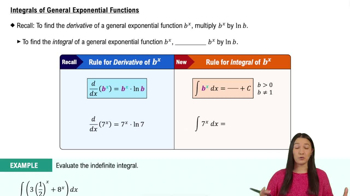
∫ 3^{-2x} dx
Verified step by step guidance
Verified video answer for a similar problem:
Key Concepts
Integration of Exponential Functions
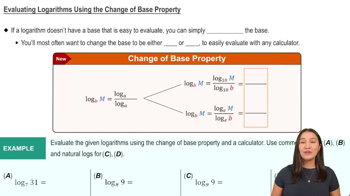
Properties of Logarithms
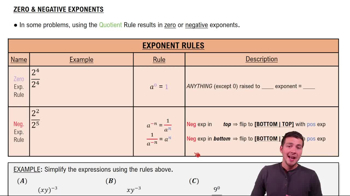
Handling Negative Exponents
Express sinh⁻¹ x in terms of logarithms.
Inverse identity Show that cosh⁻¹(cosh x) = |x| by using the formula cosh⁻¹ t = ln (t + √(t² – 1)) and considering the cases x ≥ 0 and x < 0.
22–36. Derivatives Find the derivatives of the following functions.
f(x) = cosh²x
39–40. LED lighting LED (light-emitting diode) bulbs are rapidly decreasing in cost, and they are more energy-efficient than standard incandescent light bulbs and CFL (compact fluorescent light) bulbs. By some estimates, LED bulbs last more than 40 times longer than incandescent bulbs and more than 8 times longer than CFL bulbs. Haitz’s law, which is explored in the following two exercises, predicts that over time, LED bulbs will exponentially increase in efficiency and exponentially decrease in cost.
Haitz’s law predicts that the cost per lumen of an LED bulb decreases by a factor of 10 every 10 years. This means that 10 years from now, the cost of an LED bulb will be 1/10 of its current cost. Predict the cost of a particular LED bulb in 2021 if it costs 4 dollars in 2018.

13–14. Absolute and relative growth rates Two functions f and g are given. Show that the growth rate of the linear function is constant and the relative growth rate of the exponential function is constant.
f(t) = 100 + 10.5t, g(t) = 100e^(t/10)