Ch. 2 - Limits and Continuity
Hass - Thomas' Calculus 15th Edition
Hass15th EditionThomas' CalculusISBN: 9780137616077Not the one you use?Change textbook
Chapter 2, Problem 2.5.57

Removable discontinuity Give an example of a function f (x) that is continuous for all values of x except x = 2, where it has a removable discontinuity. Explain how you know that f is discontinuous at x = 2, and how you know the discontinuity is removable.

Verified step by step guidance
1
Step 1: Consider the function f(x) = (x^2 - 4)/(x - 2). This function is defined for all x except x = 2, because at x = 2, the denominator becomes zero, which makes the function undefined.
Step 2: To determine if the discontinuity at x = 2 is removable, factor the numerator x^2 - 4. Notice that x^2 - 4 can be factored as (x - 2)(x + 2).
Step 3: Rewrite the function f(x) as f(x) = ((x - 2)(x + 2))/(x - 2). For all x ≠ 2, the (x - 2) terms in the numerator and denominator cancel out, simplifying the function to f(x) = x + 2.
Step 4: The simplified function f(x) = x + 2 is continuous for all x, including x = 2. However, the original function f(x) = (x^2 - 4)/(x - 2) is undefined at x = 2, indicating a discontinuity.
Step 5: Since the discontinuity at x = 2 can be 'removed' by redefining the function to be f(x) = x + 2 for all x, including x = 2, we conclude that the discontinuity is removable. The limit of f(x) as x approaches 2 exists and equals 4, which matches the value of the simplified function at x = 2.

Verified video answer for a similar problem:

This video solution was recommended by our tutors as helpful for the problem above.
Video duration:
3m
Was this helpful?

Key Concepts

Here are the essential concepts you must grasp in order to answer the question correctly.

Removable Discontinuity

A removable discontinuity occurs at a point in a function where the function is not defined or does not match the limit at that point, but can be 'fixed' by redefining the function at that point. For example, the function f(x) = (x^2 - 4)/(x - 2) has a removable discontinuity at x = 2 because it simplifies to f(x) = x + 2 for all x except x = 2.
Recommended video:
02:10
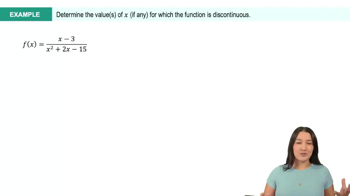
Determine Continuity Algebraically Example 3

Continuity

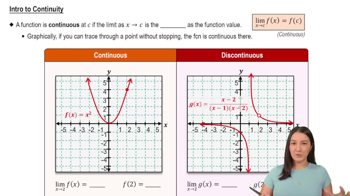
A function is continuous at a point if the limit of the function as it approaches that point equals the function's value at that point. For a function to be continuous at x = 2, it must be defined at that point, and the limit as x approaches 2 must exist and equal the function's value at x = 2.
Recommended video:
05:34
Intro to Continuity

Limit

The limit of a function describes the value that the function approaches as the input approaches a certain point. In the context of removable discontinuities, if the limit of f(x) as x approaches 2 exists and is equal to a specific value, but f(2) is not defined or does not equal that value, then the discontinuity is removable by defining f(2) to be that limit.
Recommended video:
05:50
One-Sided Limits