
Ch. 10 - Sequences and Infinite Series
Briggs - Calculus: Early Transcendentals 3rd Edition
Briggs3rd EditionCalculus: Early TranscendentalsISBN: 9780136847243Not the one you use?Change textbook
Chapter 10, Problem 10.2.83a

Explain why or why not
Determine whether the following statements are true and give an explanation or counterexample.
a.If limₙ→∞aₙ = 1 and limₙ→∞bₙ = 3, then limₙ→∞(bₙ / aₙ) = 3.

Verified step by step guidance
1
Recall the limit laws for sequences: if \( \lim_{n \to \infty} a_n = A \) and \( \lim_{n \to \infty} b_n = B \), and if \( A \neq 0 \), then \( \lim_{n \to \infty} \frac{b_n}{a_n} = \frac{B}{A} \).
Given \( \lim_{n \to \infty} a_n = 1 \) and \( \lim_{n \to \infty} b_n = 3 \), since \( a_n \) approaches 1 (which is not zero), the limit of the quotient should be \( \frac{3}{1} = 3 \).
Therefore, the statement \( \lim_{n \to \infty} \frac{b_n}{a_n} = 3 \) is true under these conditions.
To confirm, consider that the denominator sequence \( a_n \) does not approach zero, so division by \( a_n \) is well-defined in the limit.
Hence, the limit of the quotient is the quotient of the limits, which justifies the statement.

Verified video answer for a similar problem:

This video solution was recommended by our tutors as helpful for the problem above.
Video duration:
1m
Was this helpful?

Key Concepts

Here are the essential concepts you must grasp in order to answer the question correctly.

Limit of a Sequence

The limit of a sequence is the value that the terms of the sequence approach as the index goes to infinity. If a sequence converges to a limit, its terms get arbitrarily close to that limit for sufficiently large indices.
Recommended video:
Guided course
8:22
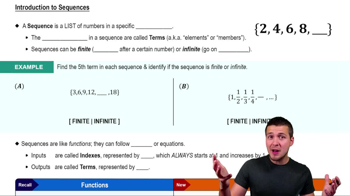
Introduction to Sequences

Limit Laws for Sequences

Limit laws allow us to compute limits of combined sequences using operations like addition, multiplication, and division, provided the limits of individual sequences exist and, in the case of division, the denominator's limit is not zero.
Recommended video:
Guided course
8:22
Introduction to Sequences

Counterexamples in Limit Problems

Counterexamples demonstrate that a general statement is false by providing a specific case where the statement fails. In limit problems, they help test the validity of limit laws or assumptions, especially when conditions like nonzero denominators are involved.
Recommended video:
05:03
Initial Value Problems
Related Practice
Textbook Question

{Use of Tech} A savings plan

James begins a savings plan in which he deposits \(100 at the beginning of each month into an account that earns 9% interest annually, or equivalently, 0.75% per month.

To be clear, on the first day of each month, the bank adds 0.75% of the current balance as interest, and then James deposits \)100.


Let Bₙ be the balance in the account after the nᵗʰ payment, where B₀ = \$0.


a.Write the first five terms of the sequence {Bₙ}.

57
views
Textbook Question

27–37. Evaluating series Evaluate the following infinite series or state that the series diverges.

∑ (from k = 0 to ∞)(tan⁻¹(k + 2) − tan⁻¹k)

81
views
Textbook Question

27–37. Evaluating series Evaluate the following infinite series or state that the series diverges.

∑ (from k = 0 to ∞)((1/3)ᵏ + (4/3)ᵏ)

51
views
Textbook Question

41–44. {Use of Tech} Remainders and estimates Consider the following convergent series.


a. Find an upper bound for the remainder in terms of n.


41. ∑ (k = 1 to ∞) 1 / k⁶

105
views
Textbook Question

Loglog p-series Consider the series ∑ (k = 2 to ∞) 1 / (k(ln k)(ln ln k)ᵖ), where p is a real number.

a. For what values of p does this series converge?

52
views
Textbook Question

89–90. {Use of Tech} Lower and upper bounds of a series

For each convergent series and given value of n, complete the following.


c. Find lower and upper bounds (Lₙ and Uₙ respectively) for the exact value of the series.


89.∑ (from k = 1 to ∞)1 / k⁵ ;n = 5

104
views