Average value of the derivative Suppose Ζ ' is a continuous function for all real numbers. Show that the average value of the derivative on an interval [a, b] is Ζβ»' = (Ζ(b) βΖ(a))/ (bβa) . Interpret this result in terms of secant lines.
Derivatives of integrals Simplify the following expressions.
d/dπ β«βΛ£ (β1 + tΒ²) dt (Hint: β«Λ£ββ (β1 + tΒ²) dt = β«β°ββ (β1 + tΒ²) dt + β«Λ£ββ (β1 + tΒ²) dt ) .
Verified step by step guidance
Verified video answer for a similar problem:
Key Concepts
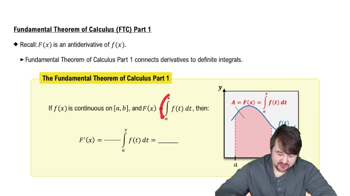
Fundamental Theorem of Calculus
Differentiation under the Integral Sign
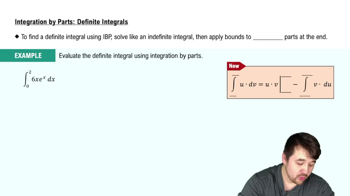
Integration by Parts
General results Evaluate the following integrals in which the function Ζ is unspecified. Note that Ζβ½α΅βΎ is the pth derivative of Ζ and Ζα΅ is the pth power of Ζ. Assume Ζ and its derivatives are continuous for all real numbers.
β« (5 ΖΒ³ (π) + 7ΖΒ² (π) + Ζ (π )) Ζ'(π) dπ
{Use of Tech} Areas of regions Find the area of the region π bounded by the graph of Ζ and the π-axis on the given interval. Graph Ζ and show the region π .
Ζ(π) = 2 β |π| on [ β 2 , 4]
The linear function Ζ(π) = 3 β π is decreasing on the interval [0, 3]. Is its area function for Ζ (with left endpoint 0) increasing or decreasing on the interval [0, 3]? Draw a picture and explain.
Approximating displacement The velocity of an object is given by the following functions on a specified interval. Approximate the displacement of the object on this interval by subdividing the interval into n subintervals. Use the left endpoint of each subinterval to compute the height of the rectangles.
v = 2t + 1(m/s), for 0 β€ t β€ 8 ; n = 2
Symmetry of composite functions Prove that the integrand is either even or odd. Then give the value of the integral or show how it can be simplified. Assume f and g are even functions and p and q are odd functions.
β«α΅ββ Ζ(p(π)) dπ
