
Ch. 5 - Integration
Briggs - Calculus: Early Transcendentals 3rd Edition
Briggs3rd EditionCalculus: Early TranscendentalsISBN: 9780136847243Not the one you use?Change textbook
Chapter 5, Problem 5.3.5

The linear function Ζ’(𝓍) = 3 ― 𝓍 is decreasing on the interval [0, 3]. Is its area function for Ζ’ (with left endpoint 0) increasing or decreasing on the interval [0, 3]? Draw a picture and explain. 

Verified step by step guidance
1
Step 1: Understand the problem. The linear function Ζ’(𝓍) = 3 - 𝓍 is given, and we are tasked to determine whether its area function (integral) is increasing or decreasing on the interval [0, 3]. The area function represents the accumulated area under the curve of Ζ’(𝓍) starting from the left endpoint 0.
Step 2: Recall the relationship between a function and its area function. The area function is the integral of Ζ’(𝓍) with respect to 𝓍. Mathematically, the area function A(𝓍) is defined as: Ax=0f(x)dx. The derivative of the area function, A'(𝓍), is equal to Ζ’(𝓍).
Step 3: Analyze the behavior of Ζ’(𝓍) on the interval [0, 3]. The function Ζ’(𝓍) = 3 - 𝓍 is linear with a negative slope (-1), meaning it decreases as 𝓍 increases. Specifically, Ζ’(𝓍) starts at 3 when 𝓍 = 0 and decreases to 0 when 𝓍 = 3.
Step 4: Determine the behavior of the area function A(𝓍). Since A'(𝓍) = Ζ’(𝓍), the area function A(𝓍) increases wherever Ζ’(𝓍) is positive. On the interval [0, 3], Ζ’(𝓍) is positive (above the x-axis), so the area function A(𝓍) is increasing throughout this interval.
Step 5: Visualize the problem. Draw the graph of Ζ’(𝓍) = 3 - 𝓍, which is a straight line decreasing from (0, 3) to (3, 0). Shade the area under the curve from 𝓍 = 0 to a variable endpoint 𝓍. As 𝓍 moves from 0 to 3, the shaded area grows, confirming that the area function A(𝓍) is increasing on [0, 3].

Verified video answer for a similar problem:

This video solution was recommended by our tutors as helpful for the problem above.
Video duration:
3m
Was this helpful?

Key Concepts

Here are the essential concepts you must grasp in order to answer the question correctly.

Decreasing Functions

A function is considered decreasing on an interval if, for any two points x1 and x2 within that interval, where x1 < x2, the function value at x1 is greater than the function value at x2 (Ζ’(x1) > Ζ’(x2)). In this case, the linear function Ζ’(𝓍) = 3 - 𝓍 decreases as x increases, indicating that as we move from 0 to 3, the output values of the function get smaller.
Recommended video:
07:32
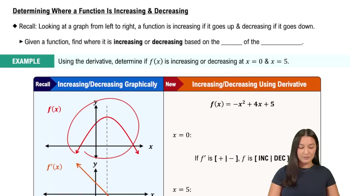
Determining Where a Function is Increasing & Decreasing

Area Function

The area function A(x) associated with a function Ζ’(𝓍) represents the accumulated area under the curve of Ζ’ from a starting point (in this case, 0) to a variable endpoint x. Mathematically, it is defined as A(x) = ∫[0,x] Ζ’(t) dt. The behavior of the area function depends on the values of the original function; if Ζ’ is decreasing, the area function will reflect this change.
Recommended video:
05:06
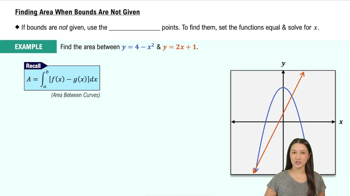
Finding Area When Bounds Are Not Given

Relationship Between Function and Area Function

The relationship between a function and its area function is governed by the Fundamental Theorem of Calculus. If the original function is decreasing, the area function will increase at a decreasing rate. This means that while the area function A(x) is increasing as x moves from 0 to 3, the rate of increase diminishes because the heights of the rectangles (representing area) are getting smaller as the function value decreases.
Recommended video:
05:23
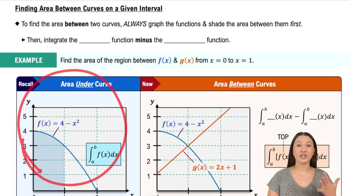
Finding Area Between Curves on a Given Interval
Related Practice
Textbook Question

General results Evaluate the following integrals in which the function Ζ’ is unspecified. Note that ƒ⁽ᡖ⁾ is the pth derivative of Ζ’ and Ζ’α΅– is the pth power of Ζ’. Assume Ζ’ and its derivatives are continuous for all real numbers. 

∫ (5 Ζ’Β³ (𝓍) + 7Ζ’Β² (𝓍) + Ζ’ (𝓍 )) Ζ’'(𝓍) d𝓍

85
views
Textbook Question

{Use of Tech} Areas of regions Find the area of the region 𝑅 bounded by the graph of Ζ’ and the 𝓍-axis on the given interval. Graph Ζ’ and show the region 𝑅.                                              


 Ζ’(𝓍) = 2 ― |𝓍| on [ ― 2 , 4]

74
views
Textbook Question

Why can the constant of integration be omitted from the antiderivative when evaluating a definite integral?

157
views
Textbook Question

Approximating displacement The velocity of an object is given by the following functions on a specified interval. Approximate the displacement of the object on this interval by subdividing the interval into n subintervals. Use the left endpoint of each subinterval to compute the height of the rectangles.

v = 2t + 1(m/s), for 0 ≀ t ≀ 8 ; n = 2

84
views
Textbook Question

Derivatives of integrals Simplify the following expressions.


d/d𝓍 βˆ«β‚€Λ£ (√1 + tΒ²) dt (Hint: βˆ«Λ£β‚‹β‚“ (√1 + tΒ²) dt = βˆ«β°β‚‹β‚“ (√1 + tΒ²) dt + βˆ«Λ£β‚‹β‚“ (√1 + tΒ²) dt ) .

60
views
Textbook Question

Symmetry of composite functions Prove that the integrand is either even or odd. Then give the value of the integral or show how it can be simplified. Assume f and g are even functions and p and q are odd functions.

βˆ«α΅ƒβ‚‹β‚ Ζ’(p(𝓍)) d𝓍

110
views