
Ch. 6 - Applications of Integration
Briggs - Calculus: Early Transcendentals 3rd Edition
Briggs3rd EditionCalculus: Early TranscendentalsISBN: 9780136847243Not the one you use?Change textbook
Chapter 6, Problem 6.4.53

53–62. Choose your method Let R be the region bounded by the following curves. Use the method of your choice to find the volume of the solid generated when R is revolved about the given axis.
y = x−x⁴,y=0; about the x-axis.

Verified step by step guidance
1
Identify the region R bounded by the curves: the function \(y = x - x^{4}\) and the line \(y = 0\). This means the region lies between the curve and the x-axis.
Determine the interval for \(x\) where the region exists by solving \(x - x^{4} = 0\). Factor the equation as \(x(1 - x^{3}) = 0\), which gives the roots \(x = 0\) and \(x = 1\). So, the region is bounded between \(x = 0\) and \(x = 1\).
Since the solid is generated by revolving the region around the x-axis, use the disk method. The volume \(V\) is given by the integral formula: \(V = \pi \int_{a}^{b} [f(x)]^{2} \, dx\), where \(f(x)\) is the function representing the radius of the disks.
In this problem, the radius of each disk is the distance from the x-axis to the curve, which is \(y = x - x^{4}\). Substitute this into the formula to get: \(V = \pi \int_{0}^{1} (x - x^{4})^{2} \, dx\).
Expand the integrand \((x - x^{4})^{2}\) and then set up the integral for evaluation. The next step would be to integrate term-by-term over the interval \([0,1]\) to find the volume.

Verified video answer for a similar problem:

This video solution was recommended by our tutors as helpful for the problem above.
Video duration:
4m

Key Concepts

Here are the essential concepts you must grasp in order to answer the question correctly.

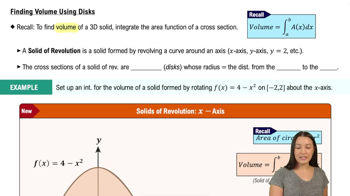
Volume of Solids of Revolution

This concept involves finding the volume of a 3D solid formed by rotating a 2D region around an axis. The volume can be computed using integral calculus by summing infinitesimal cross-sectional areas perpendicular to the axis of rotation.
Recommended video:
04:48
Finding Volume Using Disks

Disk and Washer Methods

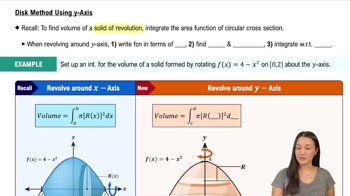
These methods calculate volume by integrating the area of circular cross-sections. The disk method applies when the region touches the axis of rotation, while the washer method is used when there is a gap, creating hollow sections.
Recommended video:
06:30
Disk Method Using y-Axis

Setting up the Integral with Given Curves

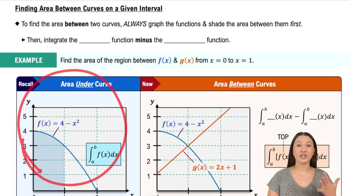
To find the volume, one must express the radius of rotation in terms of x or y using the given functions. For y = x - x⁴ and y = 0, the limits and radius are determined by these curves and the axis of rotation, guiding the integral setup.
Recommended video:
05:23
Finding Area Between Curves on a Given Interval