
Ch. 6 - Applications of Integration
Briggs - Calculus: Early Transcendentals 3rd Edition
Briggs3rd EditionCalculus: Early TranscendentalsISBN: 9780136847243Not the one you use?Change textbook
Chapter 6, Problem 6.4.1

Assume f and g are continuous, with f(x) ≥ g(x) ≥ 0 on [a, b]. The region bounded by the graphs of f and g and the lines x=a and x=b is revolved about the y-axis. Write the integral given by the shell method that equals the volume of the resulting solid.

Verified step by step guidance
1
Identify the region bounded by the curves y = f(x) and y = g(x), and the vertical lines x = a and x = b, where f(x) ≥ g(x) ≥ 0 on the interval [a, b].
Since the solid is formed by revolving this region about the y-axis, use the shell method, which involves cylindrical shells with radius equal to the distance from the y-axis, height equal to the difference between the functions, and thickness dx.
Express the radius of a typical shell as the x-value itself, since the distance from the y-axis to the shell at position x is simply x.
Express the height of the shell as the vertical distance between the two curves, which is f(x) - g(x).
Set up the integral for the volume using the shell method formula: \(V = \int_{a}^{b} 2\pi \times (\text{radius}) \times (\text{height}) \, dx = \int_{a}^{b} 2\pi x (f(x) - g(x)) \, dx\).

Verified video answer for a similar problem:

This video solution was recommended by our tutors as helpful for the problem above.
Video duration:
3m

Key Concepts

Here are the essential concepts you must grasp in order to answer the question correctly.

Shell Method for Volume

The shell method calculates the volume of a solid of revolution by integrating cylindrical shells. When revolving around the y-axis, each shell's radius is the x-value, height is the difference between the functions, and thickness is dx. The volume is found by integrating 2π(radius)(height) dx over [a, b].
Recommended video:
04:48
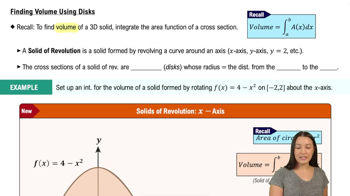
Finding Volume Using Disks

Continuous Functions and Inequalities

Continuity of f and g on [a, b] ensures no gaps or jumps, allowing proper integration. The inequality f(x) ≥ g(x) ≥ 0 guarantees the region between the curves is well-defined and non-negative, which is essential for correctly determining the height of each shell.
Recommended video:
05:34
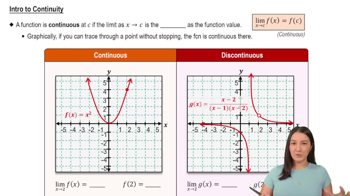
Intro to Continuity

Setting up the Integral Limits and Integrand

The integral limits correspond to the interval [a, b] on the x-axis. The integrand combines the shell radius (x) and height (f(x) - g(x)) multiplied by 2π. Correctly identifying these components is crucial to formulating the integral that represents the volume.
Recommended video:
Guided course
11:11
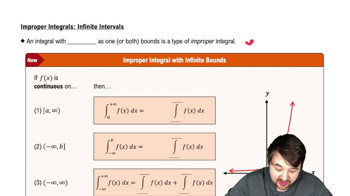
Improper Integrals: Infinite Intervals
Related Practice
Textbook Question

Leaky Bucket A 1-kg bucket resting on the ground contains 3 kg of water. How much work is required to raise the bucket vertically a distance of 10 m if water leaks out of the bucket at a constant rate of 1/5 kg/m? Assume the weight of the rope used to raise the bucket is negligible. (Hint: Use the definition of work, W = ∫a^bF(y) dy, where F is the variable force required to lift an object along a vertical line from y=a to y=b.)

72
views
Textbook Question

For the following regions R, determine which is greater—the volume of the solid generated when R is revolved about the x-axis or about the y-axis.


R is bounded by y=1−x^3, the x-axis, and the y-axis.

100
views
Textbook Question

Let R be the region bounded by the following curves. Find the volume of the solid generated when R is revolved about the given line.


x=2−secy,x=2,y=π/3, and y=0; about x=2

163
views
Textbook Question

39–44. Shell method about other lines Let R be the region bounded by y = x²,x=1, and y=0. Use the shell method to find the volume of the solid generated when R is revolved about the following lines.


x =2

48
views
Textbook Question

13–20. Mass of one-dimensional objects Find the mass of the following thin bars with the given density function.


ρ(x) = {1 if 0≤x≤2 {2 if 2<x≤3

37
views
Textbook Question

Let f(x) = {x   if 0≤x≤2

      2x−2  if 2<x≤5

      −2x+18 if 5<x≤6. 


Find the volume of the solid formed when the region bounded by the graph of f, the x-axis, and the line x=6 is revolved about the x-axis.

49
views