
Ch. 7 - Logarithmic, Exponential Functions, and Hyperbolic Functions
Briggs - Calculus: Early Transcendentals 3rd Edition
Briggs3rd EditionCalculus: Early TranscendentalsISBN: 9780136847243Not the one you use?Change textbook
Chapter 7, Problem 7.RE.2

2–9. Integrals Evaluate the following integrals.


∫ (eˣ / (4eˣ + 6)) dx

Verified step by step guidance
1
Identify the integral to solve: \(\int \frac{e^{x}}{4e^{x} + 6} \, dx\).
Notice that the denominator is a linear function of \(e^{x}\). This suggests using a substitution where \(u = 4e^{x} + 6\).
Compute the derivative of \(u\) with respect to \(x\): \(\frac{du}{dx} = 4e^{x}\). Rearranging, we get \(e^{x} dx = \frac{du}{4}\).
Rewrite the integral in terms of \(u\): replace \(e^{x} dx\) with \(\frac{du}{4}\) and the denominator with \(u\), so the integral becomes \(\int \frac{1}{u} \cdot \frac{du}{4} = \frac{1}{4} \int \frac{1}{u} \, du\).
Integrate \(\frac{1}{u}\) with respect to \(u\) to get \(\ln|u|\), then substitute back \(u = 4e^{x} + 6\) to express the answer in terms of \(x\).

Verified video answer for a similar problem:

This video solution was recommended by our tutors as helpful for the problem above.
Video duration:
2m
Was this helpful?

Key Concepts

Here are the essential concepts you must grasp in order to answer the question correctly.

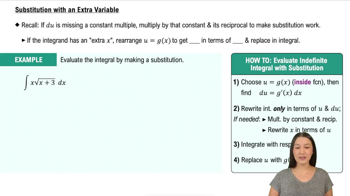
Integration by Substitution

Integration by substitution is a method used to simplify integrals by changing variables. It involves identifying a part of the integrand whose derivative also appears in the integral, allowing the integral to be rewritten in terms of a new variable, making it easier to solve.
Recommended video:
04:27
Substitution With an Extra Variable

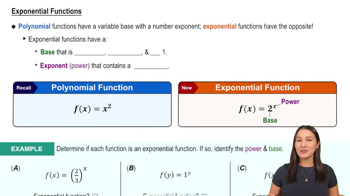
Exponential Functions

Exponential functions have the form e^x, where e is Euler's number. Their derivatives and integrals are unique because the derivative of e^x is itself, which often simplifies integration problems involving exponential terms.
Recommended video:
6:13
Exponential Functions

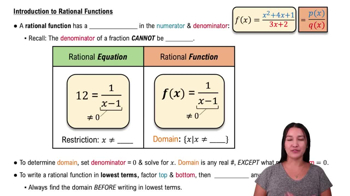
Rational Functions in Integration

Rational functions are ratios of polynomials or expressions involving variables. Integrating rational functions often requires algebraic manipulation or substitution to rewrite the integral into a more manageable form, especially when the denominator contains expressions related to the numerator.
Recommended video:
6:04
Intro to Rational Functions