Ch. 8 - Integration Techniques
Briggs - Calculus: Early Transcendentals 3rd Edition
Briggs3rd EditionCalculus: Early TranscendentalsISBN: 9780136847243Not the one you use?Change textbook
Chapter 8, Problem 8.7.46

41–48. Geometry problems Use a table of integrals to solve the following problems.
46. Find the area of the region bounded by the graph of y = 1/√(x² - 2x + 2) and the x-axis from x = 0 to x = 3.

Verified step by step guidance
1
Step 1: Recognize that the problem involves finding the area under the curve y = 1/√(x² - 2x + 2) from x = 0 to x = 3. This requires evaluating the definite integral of the function over the given interval.
Step 2: Simplify the quadratic expression x² - 2x + 2 in the denominator. Complete the square to rewrite it as (x - 1)² + 1. This step helps identify the structure of the integrand and makes it easier to match with a formula from the table of integrals.
Step 3: Refer to a table of integrals to find a formula that matches the form of the integrand. The expression 1/√((x - a)² + b²) corresponds to an arctangent integral formula: ∫ dx / √((x - a)² + b²) = (1/√b) * arctan((x - a)/√b) + C.
Step 4: Apply the formula to the given integral. Here, a = 1 and b² = 1, so √b = 1. Substitute these values into the formula to express the antiderivative of the function.
Step 5: Evaluate the definite integral by substituting the limits of integration (x = 0 and x = 3) into the antiderivative. Compute the difference between the values of the antiderivative at the upper and lower limits to find the area.

Verified video answer for a similar problem:

This video solution was recommended by our tutors as helpful for the problem above.
Video duration:
4m
Was this helpful?

Key Concepts

Here are the essential concepts you must grasp in order to answer the question correctly.

Definite Integrals

Definite integrals are used to calculate the area under a curve between two specified limits. In this problem, the area under the curve defined by the function y = 1/√(x² - 2x + 2) from x = 0 to x = 3 can be found by evaluating the definite integral of the function over that interval.
Recommended video:
05:43
Definition of the Definite Integral

Area Under a Curve

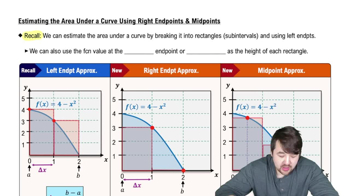
The area under a curve represents the integral of a function over a given interval. This area can be interpreted as the accumulation of values of the function, which in this case corresponds to the area between the curve and the x-axis from x = 0 to x = 3.
Recommended video:
05:59
Estimating the Area Under a Curve with Right Endpoints & Midpoint

Integral Tables

Integral tables are reference tools that provide a list of integrals and their solutions, which can simplify the process of finding areas or solving integrals. In this problem, using a table of integrals can help quickly identify the antiderivative of the function y = 1/√(x² - 2x + 2) needed to compute the definite integral.
Recommended video:
08:09
Tabular Integration by Parts