
Textbook Question
76. Different Substitutions
b. Show that ∫(1/√(x - x²)) dx = 2 sin⁻¹√x + C using substitution u = √x
44
views

 Verified step by step guidance
 06:18
06:18
 6:04
6:04 07:33
07:3376. Different Substitutions
b. Show that ∫(1/√(x - x²)) dx = 2 sin⁻¹√x + C using substitution u = √x
Practice with tabular integration Evaluate the following integrals using tabular integration (refer to Exercise 77).
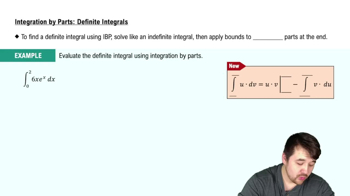
b. ∫ 7x e³ˣ dx
63. Explain why or why not Determine whether the following statements are true and give an explanation or counterexample.
b. If m is a positive integer, then ∫[0 to π] sin^m(x) dx = 0.
93. Three start-ups Three cars, A, B, and C, start from rest and accelerate along a line according to the following velocity functions:
vₐ(t) = 88t/(t + 1), v_B(t) = 88t²/(t + 1)², and v_C(t) = 88t²/(t² + 1).
b. Which car travels farthest on the interval 0 ≤ t ≤ 5?
Gamma function The gamma function is defined by Γ(p) = ∫ from 0 to ∞ of x^(p-1) e^(-x) dx, for p not equal to zero or a negative integer.
b. Use the substitution x = u² and the fact that ∫ from 0 to ∞ of e^(-u²) du = √(π/2) to show that Γ(1/2) = √π.
Area and volume Consider the function f(x) = (9 + x²)^(-1/2) and the region R on the interval [0, 4] (see figure).
b. Find the volume of the solid generated when R is revolved about the x-axis.