Ch. 8 - Integration Techniques
Briggs - Calculus: Early Transcendentals 3rd Edition
Briggs3rd EditionCalculus: Early TranscendentalsISBN: 9780136847243Not the one you use?Change textbook
Chapter 8, Problem 8.2.78e

78. Practice with tabular integration Evaluate the following integrals using tabular integration (refer to Exercise 77).
e. ∫ (2x² - 3x) / (x - 1)³ dx

Verified step by step guidance
1
First, simplify the integrand by performing polynomial division of the numerator \$2x^{2} - 3x\( by the denominator \)(x - 1)^{3}$. Since the denominator is a cubic term, consider rewriting the integrand to a form suitable for integration or partial fractions if possible.
Rewrite the integral as \(\int \frac{2x^{2} - 3x}{(x - 1)^{3}} \, dx\) and consider substituting \(u = x - 1\) to simplify the denominator. Then express the numerator in terms of \(u\) as well.
After substitution, express the integrand as a sum of terms with powers of \(u\) in the denominator, which can be integrated term-by-term. This step prepares the integral for tabular integration or direct integration of simpler terms.
Set up the tabular integration by choosing parts: let the algebraic part (powers of \(u\)) be differentiated repeatedly until it becomes zero, and the remaining part (powers of \(u\) in the denominator) be integrated repeatedly. Construct the table with derivatives and integrals accordingly.
Use the tabular integration method to combine the derivatives and integrals with alternating signs, then sum the resulting terms to write the integral in terms of \(u\). Finally, substitute back \(u = x - 1\) to express the answer in terms of \(x\).

Verified video answer for a similar problem:

This video solution was recommended by our tutors as helpful for the problem above.
Video duration:
10m
Was this helpful?

Key Concepts

Here are the essential concepts you must grasp in order to answer the question correctly.

Tabular Integration Method

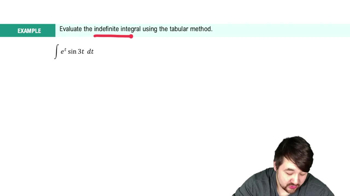
Tabular integration is a streamlined technique for integration by parts, especially useful when one function can be differentiated repeatedly to zero and the other can be easily integrated. It organizes derivatives and integrals in a table, allowing quick calculation of the integral without repeated integration by parts steps.
Recommended video:
09:15
Tabular Integration by Parts Example 6

Polynomial Division

When integrating rational functions where the numerator's degree is equal to or higher than the denominator's, polynomial division simplifies the integrand. Dividing the polynomials rewrites the integral as a sum of a polynomial and a proper fraction, making the integral easier to evaluate.
Recommended video:
07:00
Taylor Polynomials

Integration of Rational Functions

Integrating rational functions often involves rewriting the integrand into simpler parts using algebraic manipulation, partial fractions, or substitution. Recognizing the form of the denominator and numerator helps determine the best approach to find the antiderivative efficiently.
Recommended video:
6:04
Intro to Rational Functions