
Ch. 9 - Differential Equations
Briggs - Calculus: Early Transcendentals 3rd Edition
Briggs3rd EditionCalculus: Early TranscendentalsISBN: 9780136847243Not the one you use?Change textbook
Chapter 9, Problem 9.2.36a

33–36. {Use of Tech} Computing Euler approximations Use a calculator or computer program to carry out the following steps.
a. Approximate the value of y(T) using Euler’s method with the given time step on the interval [0,T].


y′(t) = t/y, y(0) = 4; Δt = 0.1, T = 2; y(t) = √(t² + 16)

Verified step by step guidance
1
Identify the differential equation and initial condition: \(y'(t) = \frac{t}{y}\) with \(y(0) = 4\).
Set the step size \(\Delta t = 0.1\) and the interval from \(t=0\) to \(T=2\). Determine the number of steps \(n = \frac{T - 0}{\Delta t} = \frac{2}{0.1} = 20\).
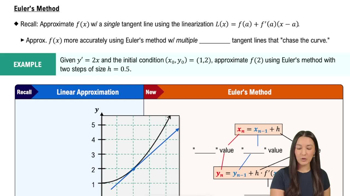
Use Euler's method formula to approximate \(y\) at each step: \(y_{k+1} = y_k + \Delta t \cdot f(t_k, y_k)\), where \(f(t, y) = \frac{t}{y}\).
Start with the initial values \(t_0 = 0\) and \(y_0 = 4\). For each step \(k\) from 0 to 19, compute \(y_{k+1}\) using the formula and update \(t_{k+1} = t_k + \Delta t\).
After completing all steps, the value \(y_{20}\) will be the Euler approximation of \(y(2)\). Compare this approximation to the exact solution \(y(t) = \sqrt{t^2 + 16}\) if desired.

Verified video answer for a similar problem:

This video solution was recommended by our tutors as helpful for the problem above.
Video duration:
3m
Was this helpful?

Key Concepts

Here are the essential concepts you must grasp in order to answer the question correctly.

Euler's Method

Euler's method is a numerical technique to approximate solutions of first-order differential equations. It uses a stepwise approach, updating the solution by moving along the slope given by the derivative at each step. This method is especially useful when an exact solution is difficult to find.
Recommended video:
07:33
Euler's Method

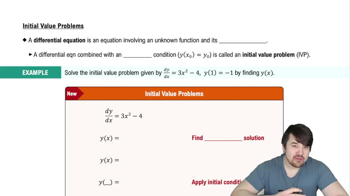
Initial Value Problems (IVP)

An initial value problem specifies the value of the solution at a starting point, allowing the differential equation to be solved uniquely. Here, y(0) = 4 sets the initial condition, which is essential for applying Euler's method to approximate y(t) over the interval.
Recommended video:
05:03
Initial Value Problems

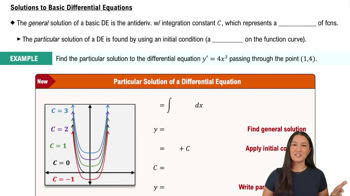
Differential Equation and Exact Solution

The differential equation y′(t) = t/y relates the rate of change of y to t and y itself. The exact solution y(t) = √(t² + 16) provides a benchmark to compare the accuracy of Euler's approximation, helping to understand the method's precision and error.
Recommended video:
04:00
Solutions to Basic Differential Equations
Related Practice
Textbook Question

{Use of Tech} Logistic equation for spread of rumors Sociologists model the spread of rumors using logistic equations. The key assumption is that at any given time, a fraction y of the population, where 0≤y≤1, knows the rumor, while the remaining fraction 1−y does not. Furthermore, the rumor spreads by interactions between those who know the rumor and those who do not. The number of such interactions is proportional to y1−y. Therefore, the equation that describes the spread of the rumor is y′(t)=ky(1−y), for t≥0 where k is a positive real number and t is measured in weeks. The number of people who initially know the rumor is y(0)=y0, where 0≤y0≤1. 

a. Solve this initial value problem and give the solution in terms of k and y0.

63
views
Textbook Question

{Use of Tech} Analytical solution of the predator-prey equations The solution of the predator-prey equations

X'(t) = -ax + bxy,y’(t) = cy - dxy

can be viewed as parametric equations that describe the solution curves. Assume a, b, c, and d are positive constants and consider solutions in the first quadrant.


a. Recalling that dy/dx = y(t)/x′(t), divide the first equation by the second equation to obtain a separable differential equation in terms of x and y.

49
views
Textbook Question

U.S. population projections According to the U.S. Census Bureau, the nation’s population (to the nearest million) was 296 million in 2005 and 321 million in 2015. The Bureau also projects a 2050 population of 398 million. To construct a logistic model, both the growth rate and the carrying capacity must be estimated. There are several ways to estimate these parameters. Here is one approach:


a. Assume t = 0 corresponds to 2005 and that the population growth is exponential for the first ten years; that is, between 2005 and 2015, the population is given by P(t) = P(0)exp(rt). Estimate the growth rate r using this assumption.

134
views
Textbook Question

A physiological model A common assumption in modeling drug assimilation is that the blood volume in a person is a single compartment that behaves like a stirred tank. Suppose the blood volume is a four-liter tank that initially has a zero concentration of a particular drug. At time t = 0, an intravenous line is inserted into a vein (into the tank) that carries a drug solution with a concentration of 500 mg/L. The inflow rate is 0.06 L/min. Assume the drug is quickly mixed thoroughly in the blood and that the volume of blood remains constant.

a. Write an initial value problem that models the mass of the drug in the blood, for t ≥ 0.

48
views
Textbook Question

Consider the differential equation y'(t)+9y(t)=10.

a. How many arbitrary constants appear in the general solution of the differential equation?

56
views
Textbook Question

38–43. Equilibrium solutions A differential equation of the form y′(t)=f(y) is said to be autonomous (the function f depends only on y). The constant function y=y0 is an equilibrium solution of the equation provided f(y0)=0 (because then y'(t)=0 and the solution remains constant for all t). Note that equilibrium solutions correspond to horizontal lines in the direction field. Note also that for autonomous equations, the direction field is independent of t. Carry out the following analysis on the given equations.

a. Find the equilibrium solutions. 


y′(t) = 6 - 2y

96
views