
Ch.12 - Parametric and Polar Curves
Briggs - Calculus: Early Transcendentals 3rd Edition
Briggs3rd EditionCalculus: Early TranscendentalsISBN: 9780136847243Not the one you use?Change textbook
Chapter 12, Problem 12.4.61

57–62. Polar equations for conic sections Graph the following conic sections, labeling the vertices, foci, directrices, and asymptotes (if they exist). Use a graphing utility to check your work.


r = 1/(2 - 2 sin θ)

Verified step by step guidance
1
Identify the form of the polar equation given: \(r = \frac{1}{2 - 2 \sin \theta}\). This resembles the general form for conic sections in polar coordinates: \(r = \frac{ed}{1 + e \cos \theta}\) or \(r = \frac{ed}{1 + e \sin \theta}\), where \(e\) is the eccentricity and \(d\) is the distance from the pole to the directrix.
Rewrite the denominator to match the standard form. Notice that \(2 - 2 \sin \theta = 2(1 - \sin \theta)\), so the equation can be expressed as \(r = \frac{1}{2(1 - \sin \theta)} = \frac{\frac{1}{2}}{1 - \sin \theta}\). This matches the form \(r = \frac{ed}{1 - e \sin \theta}\), where \(e\) and \(d\) are positive constants.
From the rewritten form, identify the eccentricity \(e\) and the product \(ed\). Since the denominator is \(1 - e \sin \theta\), and comparing to \(1 - \sin \theta\), we see that \(e = 1\). Then, \(ed = \frac{1}{2}\), so \(d = \frac{1}{2}\).
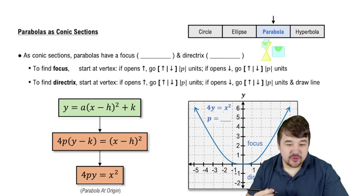
Determine the type of conic based on the eccentricity \(e\). Since \(e = 1\), the conic is a parabola. This means the curve has a single focus at the pole and a directrix line located at a distance \(d\) from the pole.
Label the key features on the graph: the focus is at the pole (origin), the directrix is the horizontal line \(y = -d\) (since the equation involves \(\sin \theta\) and the sign is negative), and the vertex is the point on the curve closest to the pole. Use the equation to find the vertex by setting \(\theta\) to the angle that minimizes \(r\).

Verified video answer for a similar problem:

This video solution was recommended by our tutors as helpful for the problem above.
Video duration:
7m
Was this helpful?

Key Concepts

Here are the essential concepts you must grasp in order to answer the question correctly.

Polar Equations of Conic Sections

Polar equations describe conic sections using the radius r and angle θ from the pole. The general form r = ed / (1 ± e sin θ) or r = ed / (1 ± e cos θ) relates eccentricity e and directrix distance d, defining ellipses, parabolas, or hyperbolas based on e's value.
Recommended video:
5:33
Parabolas as Conic Sections

Eccentricity and Classification of Conics

Eccentricity (e) measures how much a conic deviates from being circular. If e < 1, the conic is an ellipse; if e = 1, a parabola; and if e > 1, a hyperbola. Identifying e from the equation helps classify the conic and understand its geometric properties.
Recommended video:
5:33
Parabolas as Conic Sections

Graphing and Identifying Key Features

Graphing polar conics involves plotting points for various θ values and labeling vertices, foci, and directrices. Vertices are points closest or farthest from the pole, foci are fixed points defining the conic, and directrices are lines related to eccentricity. Asymptotes appear only for hyperbolas.
Recommended video:
6:22
Graphs of Secant and Cosecant Functions
Related Practice
Textbook Question

90–94. Focal chords A focal chord of a conic section is a line through a focus joining two points of the curve. The latus rectum is the focal chord perpendicular to the major axis of the conic. Prove the following properties.

Let L be the latus rectum of the parabola y ² =4px for p>0. Let F be the focus of the parabola, P be any point on the parabola to the left of L, and D be the (shortest) distance between P and L. Show that for all P, D+|FP|+ is a constant. Find the constant.

78
views
Textbook Question

Given three polar coordinate representations for the origin.

89
views
Textbook Question

Second derivative Assume a curve is given by the parametric equations x=f(t) and y=g(t), where f and g are twice differentiable. Use the Chain Rule to show that y″x=(fʹ(t)g″(t)−gʹ(t)f″(t))/(fʹ(t))³.  

43
views
Textbook Question

57–64. Graphing polar curves Graph the following equations. Use a graphing utility to check your work and produce a final graph.


r² = 4 sin θ  

54
views
Textbook Question

Air drop—inverse problem A plane traveling horizontally at 100 m/s over flat ground at an elevation of 4000 m must drop an emergency packet on a target on the ground. The trajectory of the packet is given by

x = 100t, y = −4.9t² + 4000, t ≥ 0

where the origin is the point on the ground directly beneath the plane at the moment of the release. How many horizontal meters before the target should the packet be released in order to hit the target?

47
views
Textbook Question

25–30. Converting coordinates Express the following polar coordinates in Cartesian coordinates.


(4, 5π)

69
views