Ch. 3 - Derivatives
Hass - Thomas' Calculus 15th Edition
Hass15th EditionThomas' CalculusISBN: 9780137616077Not the one you use?Change textbook
Chapter 3, Problem 3.9.32

Approximation Error


In Exercises 29–34, each function f(x) changes value when x changes from x₀ to x₀ + dx. Find


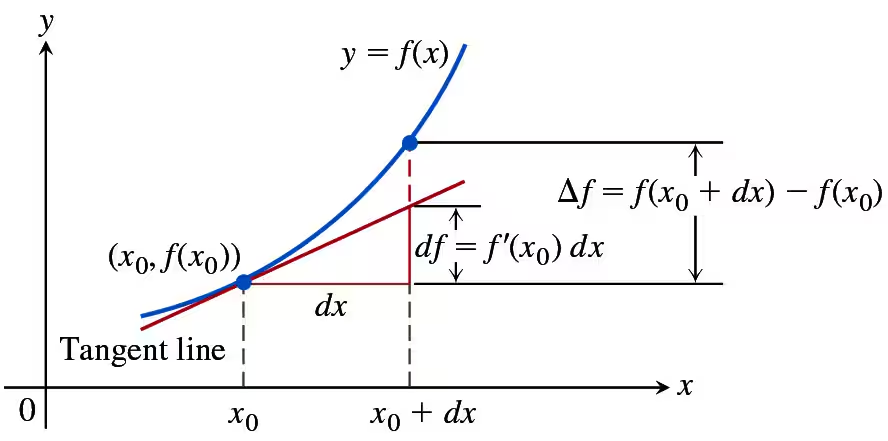
a. the change Δf = f(x₀ + dx) − f(x₀);
b. the value of the estimate df = fʹ(x₀) dx; and
c. the approximation error |Δf − df|.


Graph showing a function with a tangent line, illustrating change in value and approximation error between points.


f(x) = x⁴, x₀ = 1, dx = 0.1

Verified step by step guidance
1
Step 1: Calculate the change in the function, Δf = f(x₀ + dx) − f(x₀). For the function f(x) = x⁴, substitute x₀ = 1 and dx = 0.1 to find Δf = (1 + 0.1)⁴ - 1⁴.
Step 2: Find the derivative of the function, f'(x). For f(x) = x⁴, the derivative is f'(x) = 4x³. Evaluate this at x₀ = 1 to get f'(1) = 4(1)³.
Step 3: Calculate the estimate df = f'(x₀) dx. Using the derivative value from Step 2, df = 4(1)³ * 0.1.
Step 4: Determine the approximation error, |Δf − df|. Use the values of Δf from Step 1 and df from Step 3 to find the absolute difference.
Step 5: Interpret the results. The approximation error |Δf − df| gives an indication of how well the linear approximation (tangent line) estimates the actual change in the function over the interval from x₀ to x₀ + dx.

Verified video answer for a similar problem:

This video solution was recommended by our tutors as helpful for the problem above.
Video duration:
3m
Was this helpful?

Key Concepts

Here are the essential concepts you must grasp in order to answer the question correctly.

Change in Function (Δf)

The change in a function, denoted as Δf, represents the actual difference in the function's value as the input changes from x₀ to x₀ + dx. It is calculated as Δf = f(x₀ + dx) - f(x₀). This concept is crucial for understanding how the function behaves over a small interval and serves as the basis for comparing actual changes to approximations.
Recommended video:
06:35
Changing Geometries

Differential (df)

The differential, df, is an estimate of the change in the function based on the derivative at a specific point, multiplied by a small change in x (dx). It is expressed as df = f'(x₀) dx. This concept is essential for approximating how a function changes locally and is foundational in calculus for understanding rates of change.
Recommended video:
05:53
Finding Differentials

Approximation Error

Approximation error quantifies the difference between the actual change in the function (Δf) and the estimated change (df). It is calculated as |Δf - df|. Understanding this error is important for evaluating the accuracy of linear approximations and the effectiveness of using derivatives to predict function behavior over small intervals.
Recommended video:
04:57
Determining Error and Relative Error