
Ch. 4 - Applications of Derivatives
Hass - Thomas' Calculus 15th Edition
Hass15th EditionThomas' CalculusISBN: 9780137616077Not the one you use?Change textbook
Chapter 4, Problem 4.7.73

Initial Value Problems


Solve the initial value problems in Exercises 71–90.


dy/dx = 1/x² + x, x > 0; y(2) = 1

Verified step by step guidance
1
Identify the given differential equation and initial condition: \( \frac{dy}{dx} = \frac{1}{x^{2}} + x \), with \( y(2) = 1 \).
Rewrite the differential equation to express \( dy \) in terms of \( dx \): \( dy = \left( \frac{1}{x^{2}} + x \right) dx \).
Integrate both sides with respect to \( x \) to find the general solution: \( y = \int \left( \frac{1}{x^{2}} + x \right) dx + C \).
Compute the integral by splitting it into two parts: \( \int \frac{1}{x^{2}} dx \) and \( \int x \, dx \), then combine the results.
Use the initial condition \( y(2) = 1 \) to solve for the constant of integration \( C \) by substituting \( x = 2 \) and \( y = 1 \) into the general solution.

Verified video answer for a similar problem:

This video solution was recommended by our tutors as helpful for the problem above.
Video duration:
2m
Was this helpful?

Key Concepts

Here are the essential concepts you must grasp in order to answer the question correctly.

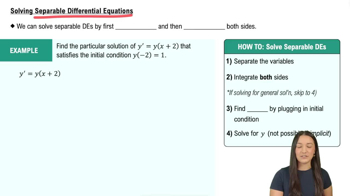
Separable Differential Equations

A separable differential equation can be written as a product of a function of x and a function of y, allowing the variables to be separated on opposite sides of the equation. This technique simplifies solving by integrating each side independently.
Recommended video:
06:06
Solving Separable Differential Equations

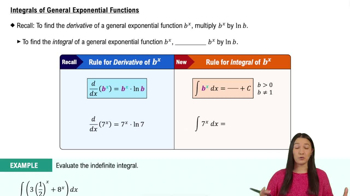
Integration of Functions

Solving dy/dx = f(x) involves integrating the right-hand side with respect to x to find the general solution y(x). Understanding how to integrate functions like 1/x² and x is essential for finding the antiderivative.
Recommended video:
05:11
Integrals of General Exponential Functions

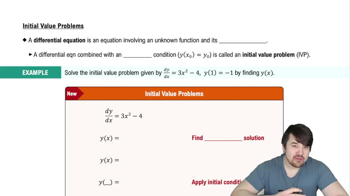
Initial Conditions and Particular Solutions

An initial value problem includes a condition like y(2) = 1, which allows determination of the constant of integration after finding the general solution. This yields a unique particular solution satisfying the given initial condition.
Recommended video:
05:03
Initial Value Problems
Related Practice
Textbook Question

In Exercises 9–66, graph the function using appropriate methods from the graphing procedures presented just before Example 9, identifying the coordinates of any local extreme points and inflection points. Then find coordinates of absolute extreme points, if any.

39. y = 8 / (x² + 4) (Witch of Agnesi)

102
views
Textbook Question

Finding Indefinite Integrals


In Exercises 17–56, find the most general antiderivative or indefinite integral. You may need to try a solution and then adjust your guess. Check your answers by differentiation.


∫(3t² + t/2) dt

29
views
Textbook Question

Finding Indefinite Integrals


In Exercises 17–56, find the most general antiderivative or indefinite integral. You may need to try a solution and then adjust your guess. Check your answers by differentiation.


∫(1 − cot²x) dx

35
views
Textbook Question

Finding Indefinite Integrals


In Exercises 17–56, find the most general antiderivative or indefinite integral. You may need to try a solution and then adjust your guess. Check your answers by differentiation.


∫(8y − 2 / y¹ᐟ⁴) dy

19
views
Textbook Question

Finding Indefinite Integrals


In Exercises 17–56, find the most general antiderivative or indefinite integral. You may need to try a solution and then adjust your guess. Check your answers by differentiation.


∫(t√t + √t) / t² dt

30
views
Textbook Question

Each of Exercises 67–88 gives the first derivative of a continuous function y=f(x). Find y'' and then use Steps 2–4 of the graphing procedure described in this section to sketch the general shape of the graph of f.

77. y' = cot(θ/2), for 0 < θ < 2π

112
views