37. Plutonium-239 The half-life of the plutonium isotope is 24,360 years. If 10 g of plutonium is released into the atmosphere by a nuclear accident, how many years will it take for 80% of the isotope to decay?
Ch. 7 - Transcendental Functions
Chapter 7, Problem 7.6.132
132. What is special about the functions
f(x) = arcsin((1/√(x²+1)) and g(x)=arctan(1/x)?
Explain.
Verified step by step guidance1
First, write down the given functions clearly: \(f(x) = \arcsin\left(\frac{1}{\sqrt{x^{2} + 1}}\right)\) and \(g(x) = \arctan\left(\frac{1}{x}\right)\).
Recall the definitions and ranges of the inverse trigonometric functions \(\arcsin\) and \(\arctan\), and consider how their arguments relate to each other.
Try to express both functions in terms of a common angle or variable by using trigonometric identities. For example, consider setting \(\theta = \arctan(x)\) and rewrite the expressions inside \(f(x)\) and \(g(x)\) in terms of \(\theta\).
Use the Pythagorean identity \(1 + \tan^{2}(\theta) = \sec^{2}(\theta)\) to simplify the expressions inside the inverse functions and see if \(f(x)\) and \(g(x)\) can be related or shown to be equal up to a constant.
Conclude by explaining that the two functions are essentially complementary angles or differ by a constant, highlighting the special relationship between \(f(x)\) and \(g(x)\).

Verified video answer for a similar problem:
This video solution was recommended by our tutors as helpful for the problem above.
Video duration:
4mWas this helpful?
Key Concepts
Here are the essential concepts you must grasp in order to answer the question correctly.
Inverse Trigonometric Functions
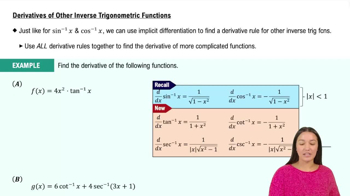
Inverse trigonometric functions like arcsin and arctan reverse the process of sine and tangent, returning an angle given a ratio. Understanding their domains and ranges is essential, as these functions are defined to produce principal values within specific intervals.
Recommended video:
Derivatives of Other Inverse Trigonometric Functions
Function Equivalence and Simplification
Determining if two functions are equivalent often involves algebraic manipulation and trigonometric identities. Simplifying expressions like arcsin(1/√(x²+1)) and arctan(1/x) can reveal hidden relationships or show that they represent the same angle under certain conditions.
Recommended video:
Properties of Functions
Relationship Between Arcsin and Arctan
Arcsin and arctan are related through right triangle definitions and trigonometric identities. For example, arcsin(1/√(x²+1)) can be expressed as arctan(1/x) by considering a triangle with sides x, 1, and √(x²+1), linking these inverse functions geometrically.
Recommended video:
Finding Area Between Curves on a Given Interval
Related Practice
Textbook Question
4
views
Textbook Question
In Exercises 115–126, use logarithmic differentiation or the method in Example 6 to find the derivative of y with respect to the given independent variable.
124. x^(sin y) = ln y
35
views
Textbook Question
In Exercises 7–26, find the derivative of y with respect to x, t, or θ, as appropriate.
y = e^(cost+lnt)
21
views
Textbook Question
Use l’Hôpital’s rule to find the limits in Exercises 7–52.
35. lim (x → 0⁺) ln(x² + 2x) / ln x
52
views
Textbook Question
Suppose that the range of g lies in the domain of f so that the composition fog is defined. If f and g are one-to-one, can anything be said about fog? Give reasons for your answer.
16
views
Textbook Question
135. Find the area of the “triangular” region in the first quadrant that is bounded above by the curve y = e^(2x), below by the curve y = e^x, and on the right by the line x = ln(3).
23
views