37. Plutonium-239 The half-life of the plutonium isotope is 24,360 years. If 10 g of plutonium is released into the atmosphere by a nuclear accident, how many years will it take for 80% of the isotope to decay?
Ch. 7 - Transcendental Functions
Chapter 7, Problem 7.3.124
In Exercises 115–126, use logarithmic differentiation or the method in Example 6 to find the derivative of y with respect to the given independent variable.
124. x^(sin y) = ln y
Verified step by step guidance1
Start with the given equation: \(x^{\sin y} = \ln y\).
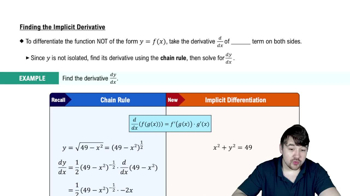
Since the equation involves both \(x\) and \(y\) in a complicated way, use implicit differentiation with respect to \(x\). Remember that \(y\) is a function of \(x\), so when differentiating terms involving \(y\), apply the chain rule.
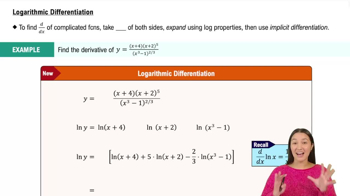
Differentiate the left side \(x^{\sin y}\) using logarithmic differentiation: first take the natural logarithm of both sides to simplify the exponentiation. That is, write \(\ln(x^{\sin y}) = \ln(\ln y)\).
Simplify the left side using logarithm properties: \(\sin y \cdot \ln x = \ln(\ln y)\).
Now differentiate both sides with respect to \(x\). For the left side, use the product rule on \(\sin y \cdot \ln x\), remembering that \(y\) depends on \(x\). For the right side, use the chain rule on \(\ln(\ln y)\).

Verified video answer for a similar problem:
This video solution was recommended by our tutors as helpful for the problem above.
Video duration:
5mWas this helpful?
Key Concepts
Here are the essential concepts you must grasp in order to answer the question correctly.
Implicit Differentiation
Implicit differentiation is used when a function is defined implicitly rather than explicitly. It involves differentiating both sides of an equation with respect to the independent variable, treating dependent variables as functions of that variable, and then solving for the derivative.
Recommended video:
Guided course
Finding The Implicit Derivative
Logarithmic Differentiation
Logarithmic differentiation simplifies differentiation of functions where variables appear as exponents or products by taking the natural logarithm of both sides. This transforms complicated expressions into sums or products, making differentiation more manageable.
Recommended video:
Logarithmic Differentiation
Chain Rule
The chain rule is a fundamental differentiation technique used when differentiating composite functions. It states that the derivative of a composite function is the derivative of the outer function evaluated at the inner function times the derivative of the inner function.
Recommended video:
Intro to the Chain Rule
Related Practice
Textbook Question
4
views
Textbook Question
Indeterminate Powers and Products
Find the limits in Exercises 53–68.
63. lim (x → ∞) ((x + 2)/(x - 1))^x
18
views
Textbook Question
In Exercises 7–26, find the derivative of y with respect to x, t, or θ, as appropriate.
y = e^(cost+lnt)
21
views
Textbook Question
132. What is special about the functions
f(x) = arcsin((1/√(x²+1)) and g(x)=arctan(1/x)?
Explain.
26
views
Textbook Question
Use l’Hôpital’s rule to find the limits in Exercises 7–52.
35. lim (x → 0⁺) ln(x² + 2x) / ln x
52
views
Textbook Question
135. Find the area of the “triangular” region in the first quadrant that is bounded above by the curve y = e^(2x), below by the curve y = e^x, and on the right by the line x = ln(3).
23
views