To isolate \(x\), raise both sides of the equation to the reciprocal of the exponent \(\frac{2}{3}\), which is \(\frac{3}{2}\). This gives: \(\left(x^{2/3}\right)^{3/2} = 4^{3/2}\).
Simplify the left side using the power of a power property: \(x^{(2/3) \times (3/2)} = x^1 = x\).
Rewrite the right side \$4^{3/2}$ as \(\left(4^{1/2}\right)^3\), which means take the square root of 4 and then cube the result.
Calculate the right side step-by-step (square root of 4 is 2, then cube 2) to find the value of \(x\).
Verified video answer for a similar problem:
This video solution was recommended by our tutors as helpful for the problem above
Video duration:
2m
Play a video:
0 Comments
Key Concepts
Here are the essential concepts you must grasp in order to answer the question correctly.
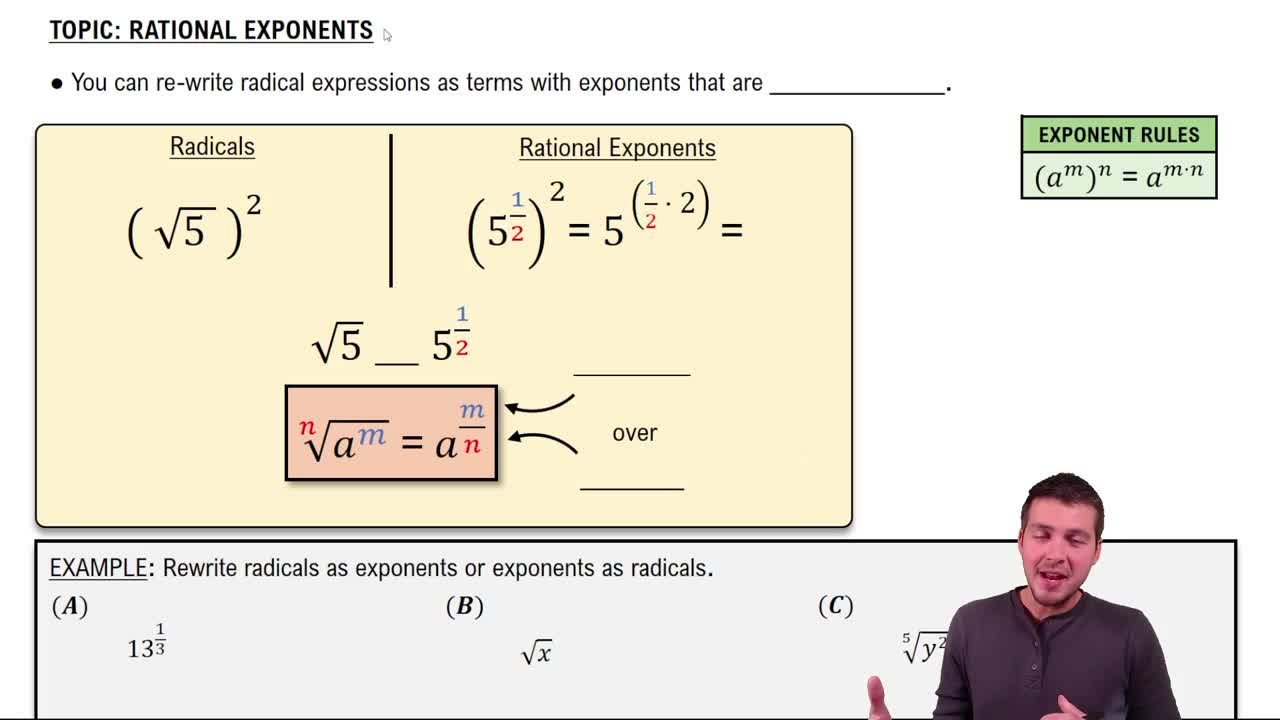
Rational Exponents
Rational exponents represent roots and powers simultaneously. For example, x^(2/3) means the cube root of x squared, or (x^2)^(1/3). Understanding how to manipulate and interpret these exponents is essential for solving equations involving fractional powers.
To solve equations, isolate the term containing the variable by performing inverse operations. In this case, you want to isolate x^(2/3) before applying further steps, which simplifies the process of solving for x.
Equations with rational exponents often require rewriting the expression as a radical and then raising both sides to an appropriate power to eliminate the root. This step helps to solve for the variable and check for extraneous solutions.