Ch. 3 - Polynomial and Rational Functions
Lial - College Algebra 13th Edition
Lial13th EditionCollege AlgebraISBN: 9780136881063Not the one you use?Change textbook
Chapter 4, Problem 18

Graph each function. Determine the largest open intervals of the domain over which each function is (a) increasing or (b) decreasing. ƒ(x)=(1/3)(x+3)4-3

Verified step by step guidance
1
Identify the function given: \(f(x) = \frac{1}{3}(x+3)^4 - 3\). This is a polynomial function involving a quartic term shifted horizontally and vertically.
Find the first derivative \(f'(x)\) to determine where the function is increasing or decreasing. Use the power rule and chain rule: \(f'(x) = \frac{1}{3} \cdot 4(x+3)^3 = \frac{4}{3}(x+3)^3\).
Set the derivative equal to zero to find critical points: \(\frac{4}{3}(x+3)^3 = 0\). Solve for \(x\) to find critical values where the function could change from increasing to decreasing or vice versa.
Analyze the sign of \(f'(x)\) on intervals determined by the critical points. Since the derivative is a cubic expression, test values less than and greater than the critical point \(x = -3\) to see if \(f'(x)\) is positive (increasing) or negative (decreasing).
Based on the sign analysis, conclude the largest open intervals where \(f(x)\) is increasing or decreasing. Remember, if \(f'(x) > 0\) on an interval, \(f\) is increasing there; if \(f'(x) < 0\), \(f\) is decreasing.

Verified video answer for a similar problem:

This video solution was recommended by our tutors as helpful for the problem above.
Video duration:
7m
Was this helpful?

Key Concepts

Here are the essential concepts you must grasp in order to answer the question correctly.

Domain of a Function

The domain of a function is the set of all possible input values (x-values) for which the function is defined. For polynomial and polynomial-like functions such as ƒ(x) = (1/3)(x+3)^4 - 3, the domain is all real numbers since there are no restrictions like division by zero or square roots of negative numbers.
Recommended video:
3:51
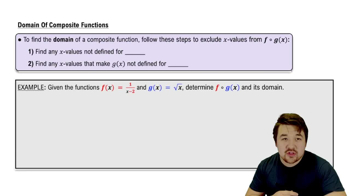
Domain Restrictions of Composed Functions

Increasing and Decreasing Intervals

A function is increasing on an interval if its output values rise as x increases, and decreasing if its output values fall as x increases. Identifying these intervals involves analyzing the function's behavior, often using the first derivative to determine where the slope is positive (increasing) or negative (decreasing).
Recommended video:
05:01
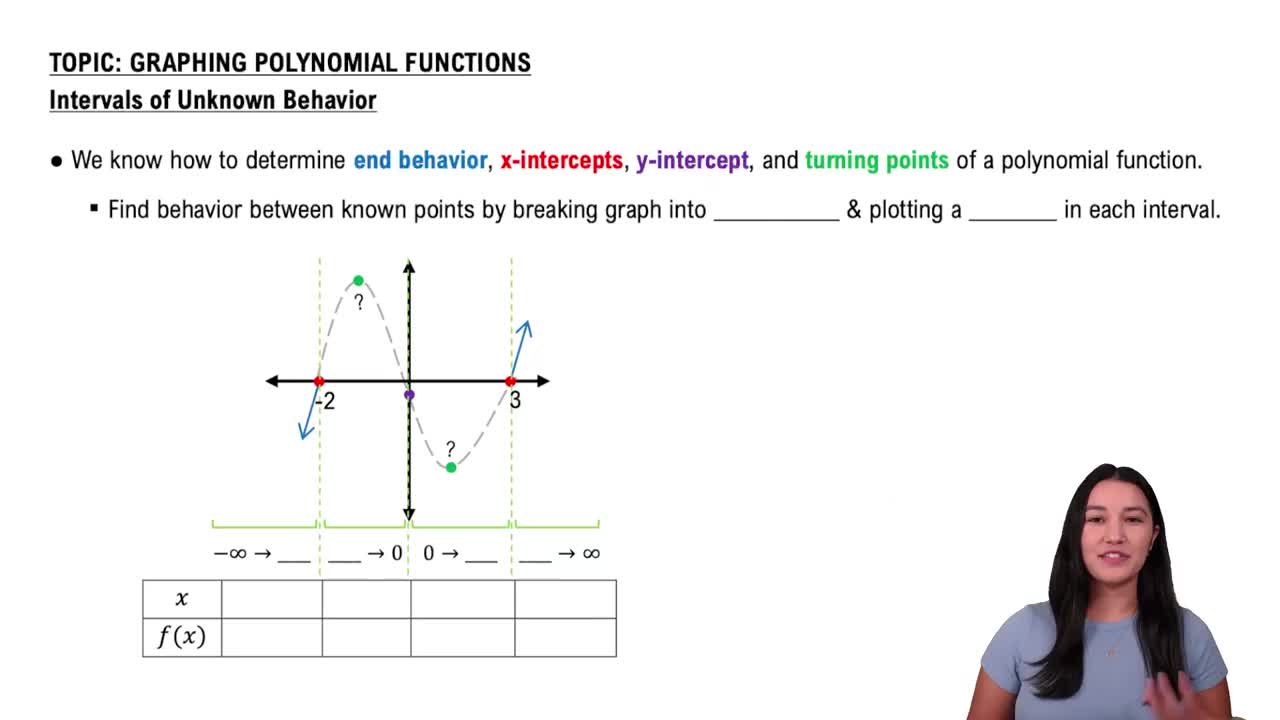
Identifying Intervals of Unknown Behavior

Using the First Derivative to Analyze Function Behavior

The first derivative of a function gives the rate of change or slope at any point. By finding where the derivative is zero or undefined, we locate critical points that help divide the domain into intervals. Testing the sign of the derivative on these intervals reveals where the function is increasing or decreasing.
Recommended video:
06:08
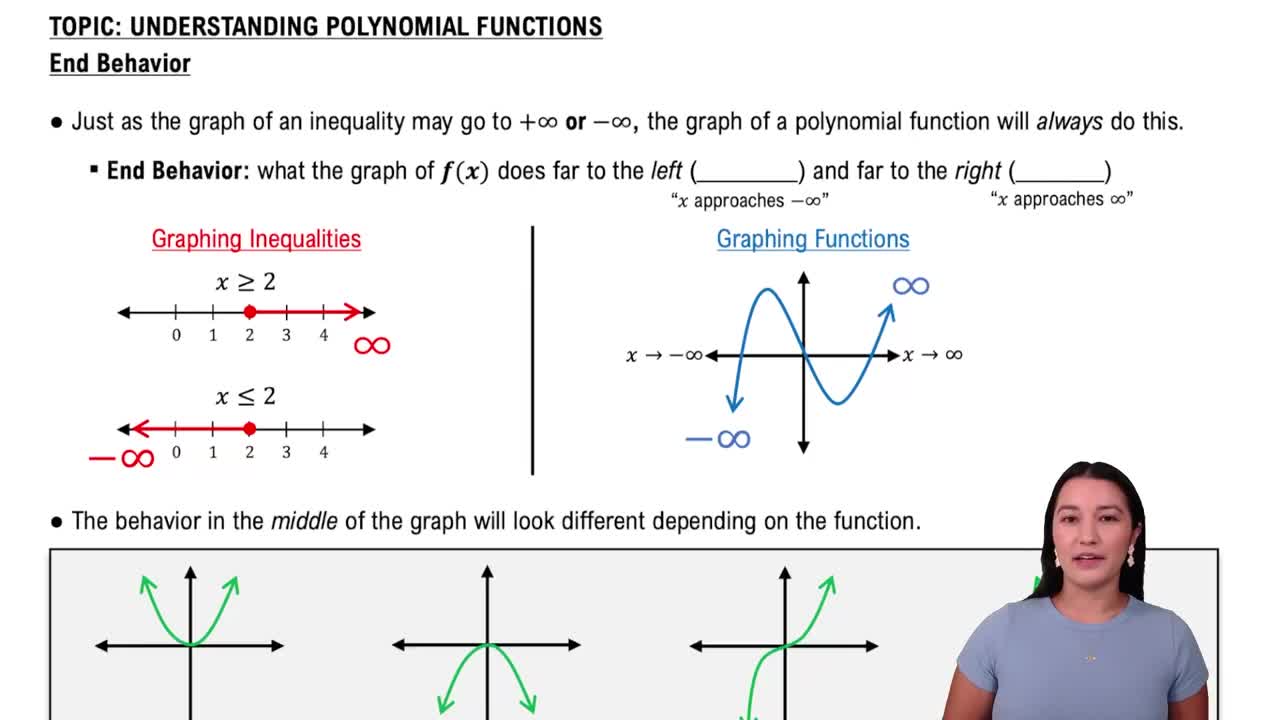
End Behavior of Polynomial Functions