Let U = {0, 1, 2, 3, 4, 5, 6, 7, 8, 9, 10, 11, 12, 13}, M = {0, 2, 4, 6, 8}, N = {1, 3, 5, 7, 9, 11, 13}, Q = {0, 2, 4, 6, 8, 10, 12}, and R = {0, 1, 2, 3, 4}.Use these sets to find each of the following. Identify any disjoint sets. (M ∩ N) ∪ R
Ch. R - Review of Basic Concepts

Chapter 1, Problem 96
Add or subtract as indicated. 46.88 - 13.45
Verified step by step guidance1
Identify the operation to perform, which is subtraction: \(46.88 - 13.45\).
Align the numbers by their decimal points to ensure correct subtraction of corresponding place values.
Subtract the digits starting from the rightmost decimal place (hundredths place), moving left through the tenths, units, and tens places.
If necessary, borrow from the next left digit when the top digit is smaller than the bottom digit in any place value.
Write down the result of the subtraction, keeping the decimal point aligned in the answer.

Verified video answer for a similar problem:
This video solution was recommended by our tutors as helpful for the problem above.
Video duration:
37sWas this helpful?
Key Concepts
Here are the essential concepts you must grasp in order to answer the question correctly.
Decimal Subtraction
Decimal subtraction involves subtracting numbers that have digits to the right of the decimal point. It requires aligning the decimal points vertically to ensure digits in the same place value are subtracted correctly.
Recommended video:
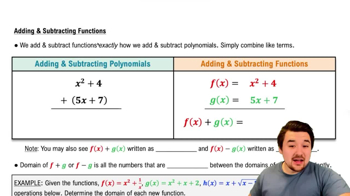
Adding & Subtracting Functions
Place Value Alignment
When performing operations with decimals, it is essential to line up the decimal points so that digits representing the same place values (ones, tenths, hundredths, etc.) are in the same column. This prevents errors in calculation.
Recommended video:
Guided course
Solving Systems of Equations - Elimination
Basic Arithmetic Operations
Understanding how to perform basic arithmetic operations like subtraction is fundamental. This includes borrowing when the top digit is smaller than the bottom digit in a given place value, ensuring accurate results.
Recommended video:
Guided course
Arithmetic Sequences - Recursive Formula
Related Practice
Textbook Question
946
views
Textbook Question
Factor by any method. See Examples 1–7.
939
views
Textbook Question
Simplify each rational expression. Assume all variable expressions represent positive real numbers. (Hint: Use factoring and divide out any common factors as a first step.) [(x2 +1)4(2x) - x2(4)(x2+1)3(2x)] / [(x2+1)8]
483
views
Textbook Question
Evaluate each expression. (-2/9 -1/4) - {-5/18 - (-1/2)}
1079
views
Textbook Question
Simplify each rational expression. Assume all variable expressions represent positive real numbers. (Hint: Use factoring and divide out any common factors as a first step.) [(y2 +2)5(3y) - y3(6)(y2+2)4(3y)] / [(y2+2)7]
692
views
Textbook Question
Perform the indicated operations. Assume all variables represent positive real numbers.
903
views