
Exercises 41–60 contain rational equations with variables in denominators. For each equation, a. write the value or values of the variable that make a denominator zero. These are the restrictions on the variable. b. Keeping the restrictions in mind, solve the equation. 5/2x - 8/9 = 1/18 - 1/3x
Ch. 1 - Equations and Inequalities

Chapter 2, Problem 45
In all exercises, other than exercises with no solution, use interval notation to express solution sets and graph each solution set on a number line. In Exercises 27–50, solve each linear inequality. (x - 4)/6 ≥ (x - 2)/9 + 5/18
Verified step by step guidance1
Start by writing down the inequality: \(\frac{(x - 4)}{6} \geq \frac{(x - 2)}{9} + \frac{5}{18}\).
To eliminate the fractions, find the least common denominator (LCD) of 6, 9, and 18, which is 18. Multiply every term on both sides of the inequality by 18 to clear the denominators.
After multiplying, simplify each term: \(18 \times \frac{(x - 4)}{6} = 3(x - 4)\), \(18 \times \frac{(x - 2)}{9} = 2(x - 2)\), and \(18 \times \frac{5}{18} = 5\).
Rewrite the inequality without fractions: \(3(x - 4) \geq 2(x - 2) + 5\). Then, distribute the constants inside the parentheses: \(3x - 12 \geq 2x - 4 + 5\).
Combine like terms on the right side: \$2x - 4 + 5 = 2x + 1\(. Now, solve the inequality \(3x - 12 \geq 2x + 1\) by isolating \)x$ on one side.

Verified video answer for a similar problem:
This video solution was recommended by our tutors as helpful for the problem above.
Video duration:
3mWas this helpful?
Key Concepts
Here are the essential concepts you must grasp in order to answer the question correctly.
Solving Linear Inequalities
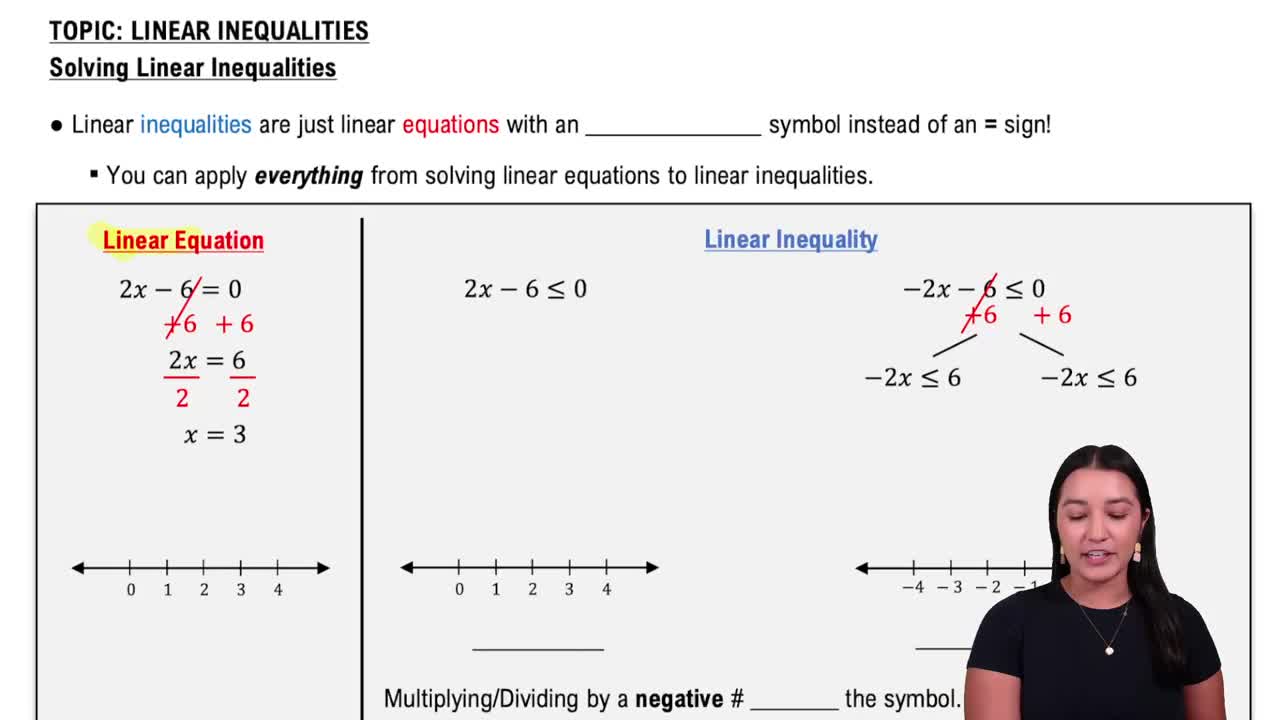
Linear inequalities involve expressions with variables raised to the first power and inequality symbols (>, <, ≥, ≤). Solving them requires isolating the variable on one side while maintaining the inequality's direction, often by performing algebraic operations like addition, subtraction, multiplication, or division.
Recommended video:
Linear Inequalities
Manipulating Fractions in Inequalities
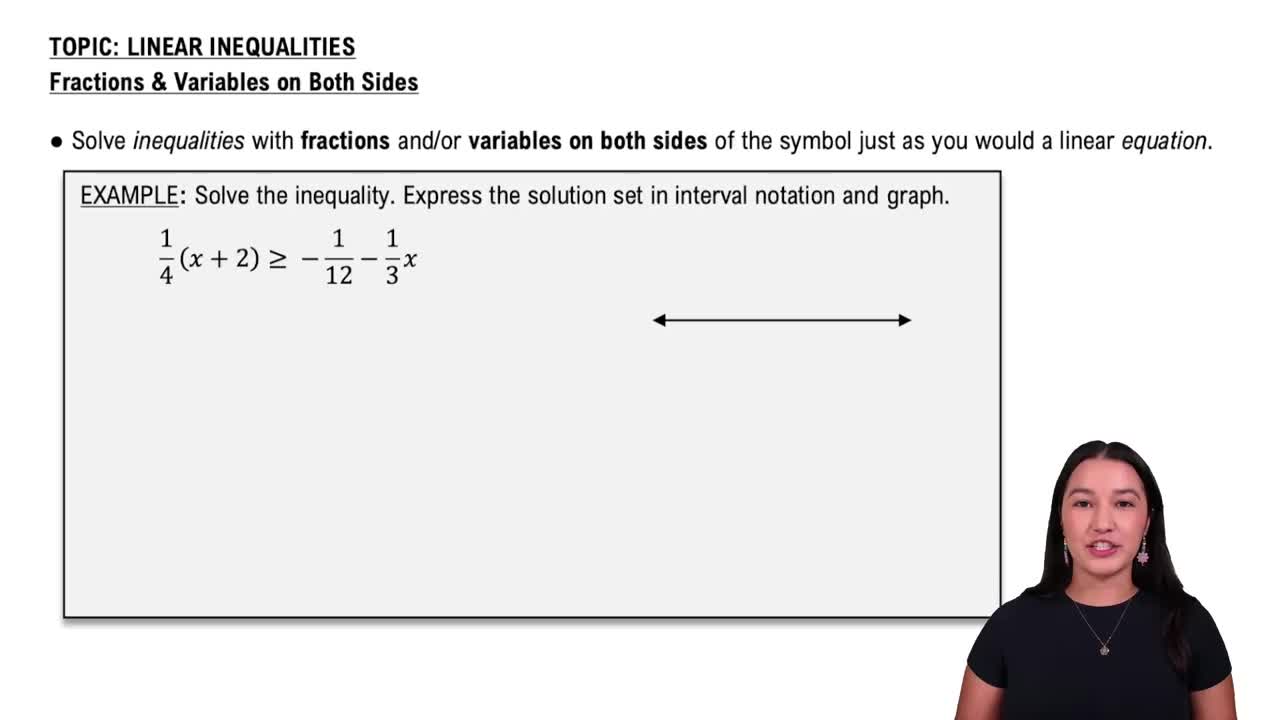
When solving inequalities with fractions, it is important to find a common denominator or clear fractions by multiplying both sides by the least common denominator. Care must be taken when multiplying or dividing by negative numbers, as this reverses the inequality sign.
Recommended video:
Linear Inequalities with Fractions & Variables on Both Sides
Interval Notation and Graphing Solutions
Interval notation expresses solution sets as intervals on the number line, using parentheses for strict inequalities and brackets for inclusive inequalities. Graphing these solutions involves shading the appropriate region on a number line and indicating boundary points as open or closed dots based on the inequality.
Recommended video:
Interval Notation
Related Practice
Textbook Question
966
views
Textbook Question
Solve each equation in Exercises 41–60 by making an appropriate substitution. x - 13√x + 40 = 0
564
views
Textbook Question
Use the graph to a. determine the x-intercepts, if any; b. determine the y-intercepts, if any. For each graph, tick marks along the axes represent one unit each.
111
views
Textbook Question
Use the graph to a. determine the x-intercepts, if any; b. determine the y-intercepts, if any. For each graph, tick marks along the axes represent one unit each.
1084
views
Textbook Question
In Exercises 45–47, solve each formula for the specified variable. vt + gt^2 = s for g
652
views
Textbook Question
In Exercises 37–52, perform the indicated operations and write the result in standard form. (- 8 + √-32)/24
1199
views
