Solve each problem. See Example 2. Elwyn averaged 50 mph traveling from Denver to Minneapolis. Returning by a different route that covered the same number of miles, he averaged 55 mph. What is the distance between the two cities to the nearest ten miles if his total traveling time was 32 hr?
Ch. 1 - Equations and Inequalities

Chapter 2, Problem 20
Solve each equation. 4[2x-(3-x)+5] = -6x - 28
Verified step by step guidance1
Start by simplifying the expression inside the brackets: \$4[2x - (3 - x) + 5] = -6x - 28\(. First, distribute the negative sign inside the parentheses: \)2x - 3 + x + 5$.
Combine like terms inside the brackets: \$2x + x - 3 + 5\( simplifies to \)3x + 2$.
Rewrite the equation with the simplified bracket: \$4(3x + 2) = -6x - 28$.
Distribute the 4 across the terms inside the parentheses: \(4 \times 3x + 4 \times 2 = 12x + 8\).
Set up the equation \$12x + 8 = -6x - 28\( and then solve for \)x\( by moving all \)x$ terms to one side and constants to the other side.

Verified video answer for a similar problem:
This video solution was recommended by our tutors as helpful for the problem above.
Video duration:
4mWas this helpful?
Key Concepts
Here are the essential concepts you must grasp in order to answer the question correctly.
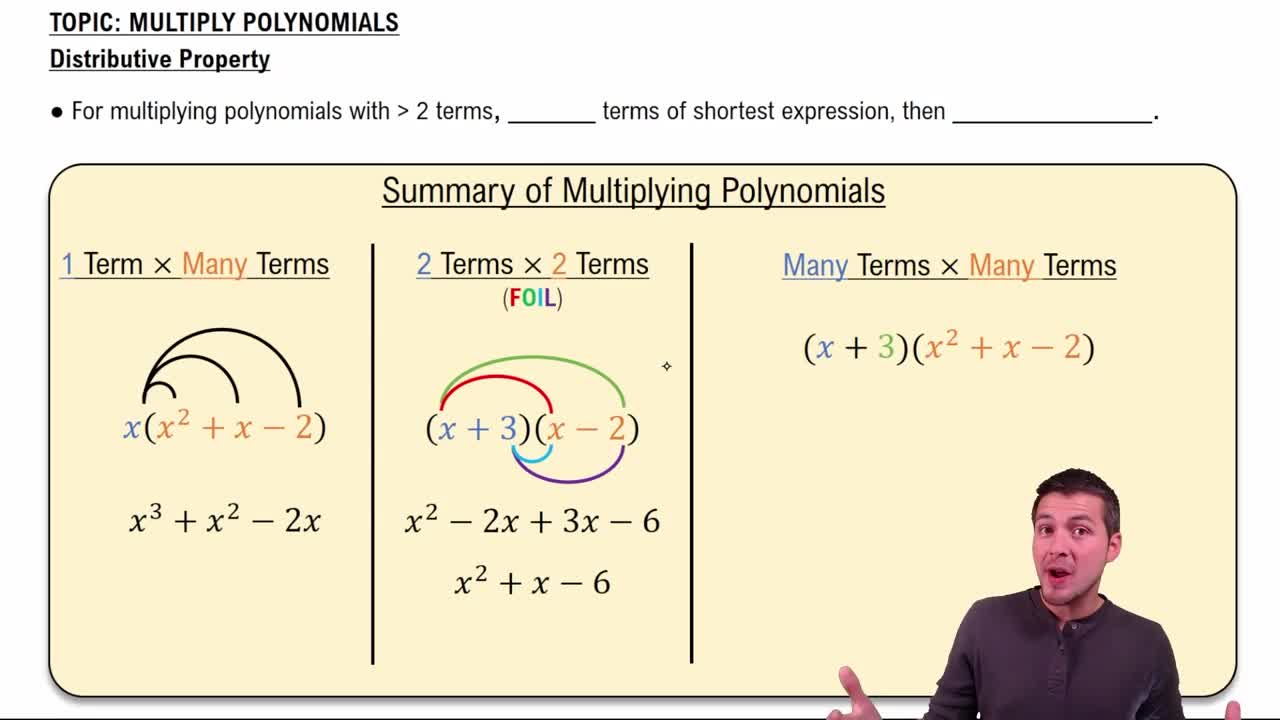
Distributive Property
The distributive property allows you to multiply a single term outside the parentheses by each term inside the parentheses. For example, a(b + c) = ab + ac. This property is essential for simplifying expressions like 4[2x - (3 - x) + 5] before solving the equation.
Recommended video:
Guided course
Multiply Polynomials Using the Distributive Property
Combining Like Terms
Combining like terms involves adding or subtracting terms that have the same variable raised to the same power. This simplifies expressions and makes solving equations easier. For instance, 2x and -x can be combined to get x.
Recommended video:
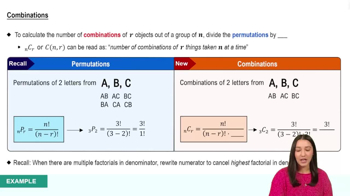
Combinations
Solving Linear Equations
Solving linear equations means finding the value of the variable that makes the equation true. This involves isolating the variable on one side using inverse operations like addition, subtraction, multiplication, or division. The goal is to simplify the equation step-by-step until the variable is alone.
Recommended video:
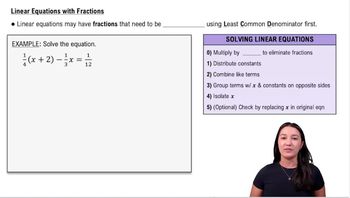
Solving Linear Equations with Fractions
Related Practice
Textbook Question
660
views
Textbook Question
Solve each equation. |x + 1 | = |1 -3x|
633
views
Textbook Question
Solve each equation using the zero-factor property. x2 - 64 = 0
1197
views
Textbook Question
Solve each equation. x/(x-4) = 4/(x-4) + 4
542
views
Textbook Question
Dimensions of a Square. The length of each side of a square is 3 in. more than the length of each side of a smaller square. The sum of the areas of the squares is 149 in.2. Find the lengths of the sides of the two squares.
1156
views
Textbook Question
Identify each number as real, complex, pure imaginary, or nonreal com-plex. (More than one of these descriptions will apply.) √-36
1069
views